
2024 question paper
Design & Analysis of Algorithms
28 questions
Q1a. Assume that the algorithms considered here sort the input sequences in ascending order. If the input is already in ascending order, which of the following is TRUE? I. Quicksort runs in \Theta(n^2) time II. Bubblesort runs in \Theta(n^2) time III. Mergesort runs in \Theta(n) time IV. Insertion sort runs in \Theta(n) time - (i) I and II only - (ii) I and III only - (iii) II and IV only - (iv) I and IV only20242m
Module 2: Divide and Conquer Paradigm and Heaps
View this question on its own page →Assume that the algorithms considered here sort the input sequences in ascending order. If the input is already in ascending order, which of the following is TRUE?
I. Quicksort runs in time
II. Bubblesort runs in time
III. Mergesort runs in time
IV. Insertion sort runs in time- (i) I and II only
- (ii) I and III only
- (iii) II and IV only
- (iv) I and IV only
Q1b. Worst-case complexity of heap sort is - - (i) O(\log n) - (ii) O(n^2) - (iii) O(n \log n) - (iv) O(n)20242m
Module 2: Divide and Conquer Paradigm and Heaps
View this question on its own page →Worst-case complexity of heap sort is -
- (i)
- (ii)
- (iii)
- (iv)
Q1c. The worst case running times of Insertion sort, Merge sort and Quick sort, respectively, are: - (i) \Theta(n \log n), \Theta(n \log n) and \Theta(n^2) - (ii) \Theta(n^2), \Theta(n^2) and \Theta(n \log n) - (iii) \Theta(n^2), \Theta(n \log n) and \Theta(n \log n) - (iv) \Theta(n^2), \Theta(n \log n) and \Theta(n^2)20242m
Module 2: Divide and Conquer Paradigm and Heaps
View this question on its own page →The worst case running times of Insertion sort, Merge sort and Quick sort, respectively, are:
- (i) , and
- (ii) , and
- (iii) , and
- (iv) , and
Q1d. The minimum number of comparisons required to determine if an integer appears more than n/2 times in a sorted array of n integers is - (i) O(n) - (ii) O(\log n) - (iii) O(n \log n) - (iv) O(1)20242m
Module 2: Divide and Conquer Paradigm and Heaps
View this question on its own page →The minimum number of comparisons required to determine if an integer appears more than times in a sorted array of integers is
- (i)
- (ii)
- (iii)
- (iv)
Q1e. What is the minimum number of stacks of size n required to implement a queue of size n - (i) one - (ii) two - (iii) three - (iv) four20242m
Module 1: Introduction and Complexity Analysis
View this question on its own page →What is the minimum number of stacks of size required to implement a queue of size
- (i) one
- (ii) two
- (iii) three
- (iv) four
Q1f. Dijkstra's algorithm is used to solve ______ problems? - (i) Single source shortest path - (ii) All pair shortest path - (iii) Sorting - (iv) Searching20242m
Module 4: Graph and Tree Algorithms
View this question on its own page →Dijkstra's algorithm is used to solve ______ problems?
- (i) Single source shortest path
- (ii) All pair shortest path
- (iii) Sorting
- (iv) Searching
Q1g. The approach followed in Floyd Warshall's algorithm is - (i) Greedy approach - (ii) Dynamic approach - (iii) Backtracking - (iv) Divide and conquer20242m
Module 4: Graph and Tree Algorithms
View this question on its own page →The approach followed in Floyd Warshall's algorithm is
- (i) Greedy approach
- (ii) Dynamic approach
- (iii) Backtracking
- (iv) Divide and conquer
Q1h. Hamiltonian path problem is ______? - (i) NP Problem - (ii) NP Complete - (iii) P Class Problem - (iv) N Class Problem20242m
Module 5: Tractable and Intractable Problems
View this question on its own page →Hamiltonian path problem is ______?
- (i) NP Problem
- (ii) NP Complete
- (iii) P Class Problem
- (iv) N Class Problem
Q1i. Which of the following algorithms are used to find the shortest path from a source node to all other nodes in a weighted graph? - (i) BFS - (ii) Prim's Algorithm - (iii) Djikstra's Algorithm - (iv) Kruskal's Algorithm20242m
Module 4: Graph and Tree Algorithms
View this question on its own page →Which of the following algorithms are used to find the shortest path from a source node to all other nodes in a weighted graph?
- (i) BFS
- (ii) Prim's Algorithm
- (iii) Djikstra's Algorithm
- (iv) Kruskal's Algorithm
Q1j. Kruskal's Algorithm for finding the Minimum Spanning Tree of a graph is a kind of a? - (i) DP Problem - (ii) Greedy Algorithm - (iii) Adhoc Problem - (iv) None of the above20242m
Module 3: Greedy, Dynamic Programming and Other Paradigms
View this question on its own page →Kruskal's Algorithm for finding the Minimum Spanning Tree of a graph is a kind of a?
- (i) DP Problem
- (ii) Greedy Algorithm
- (iii) Adhoc Problem
- (iv) None of the above
- Install PocketlyBudget App•POCKETLY
Pocketly on Android
Log daily food, travel, and hostel expenses instantly. Set monthly spending limits and see where your money goes without complex spreadsheets.
Q2a. Define Asymptotic Notation. Show that n^2 + 3\log n = O(n^2)20247m
Module 1: Introduction and Complexity Analysis
View this question on its own page →Define Asymptotic Notation. Show that
Q2b. Solve the recurrence relation T(n) = 2T(n/2) + O(n)20247m
Module 1: Introduction and Complexity Analysis
View this question on its own page →Solve the recurrence relation
Q3a. Write Divide - And - Conquer Quick sort algorithm and analyze the algorithm for average time complexity.20247m
Module 2: Divide and Conquer Paradigm and Heaps
View this question on its own page →Write Divide - And - Conquer Quick sort algorithm and analyze the algorithm for average time complexity.
Q3b. Simulate Quick sort algorithm for the following example 25, 36, 12, 4, 5, 16, 58, 54, 24, 16, 9, 65, 7820247m
Module 2: Divide and Conquer Paradigm and Heaps
View this question on its own page →Simulate Quick sort algorithm for the following example
25, 36, 12, 4, 5, 16, 58, 54, 24, 16, 9, 65, 78Q4a. Construct the max heap for the following: 35 33 42 10 14 19 27 44 26 3120247m
Module 2: Divide and Conquer Paradigm and Heaps
View this question on its own page →Construct the max heap for the following: 35 33 42 10 14 19 27 44 26 31
Q4b. Explain Strassen's matrix multiplication and its time complexity.20247m
Module 2: Divide and Conquer Paradigm and Heaps
View this question on its own page →Explain Strassen's matrix multiplication and its time complexity.
Q5a. State Huffman Tree. Explain with examples.20247m
Module 3: Greedy, Dynamic Programming and Other Paradigms
View this question on its own page →State Huffman Tree. Explain with examples.
Q5b. What are NP- hard and NP-complete problems?20247m
Module 5: Tractable and Intractable Problems
View this question on its own page →What are NP- hard and NP-complete problems?
Q6a. How 8-Queen's problem can be solved using back tracking and explain with an example.20247m
Module 3: Greedy, Dynamic Programming and Other Paradigms
View this question on its own page →How 8-Queen's problem can be solved using back tracking and explain with an example.
Q6b. Distinguish greedy method and dynamic programming20247m
Module 3: Greedy, Dynamic Programming and Other Paradigms
View this question on its own page →Distinguish greedy method and dynamic programming
- Install PocketlyBudget App•POCKETLY
Pocketly on Android
Log daily food, travel, and hostel expenses instantly. Set monthly spending limits and see where your money goes without complex spreadsheets.
Q7a. Construct minimum cost spanning tree using Kruskal's algorithm 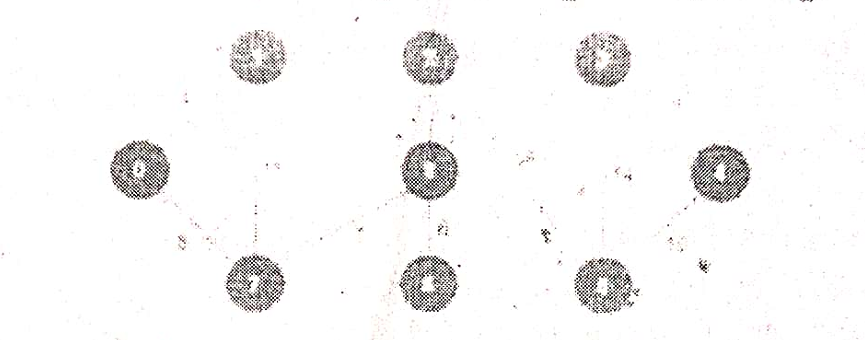20247m
Module 3: Greedy, Dynamic Programming and Other Paradigms
View this question on its own page →Construct minimum cost spanning tree using Kruskal's algorithm

Q7b. Define spanning tree and minimum spanning tree20247m
Module 3: Greedy, Dynamic Programming and Other Paradigms
View this question on its own page →Define spanning tree and minimum spanning tree
Q8a. Apply single source shortest path algorithm for the following graph 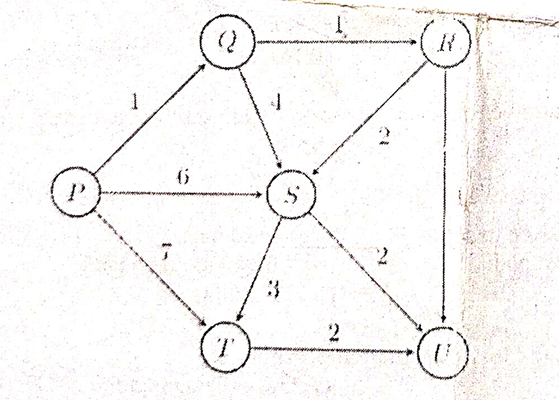20247m
Module 4: Graph and Tree Algorithms
View this question on its own page →Apply single source shortest path algorithm for the following graph

Q8b. Explain Knapsack Problem.20247m
Module 3: Greedy, Dynamic Programming and Other Paradigms
View this question on its own page →Explain Knapsack Problem.
Q9a. Write short notes on: Cook's Theorem20247m
Module 5: Tractable and Intractable Problems
View this question on its own page →Write short notes on: Cook's Theorem
Q9b. Write short notes on: Topological sorting20247m
Module 4: Graph and Tree Algorithms
View this question on its own page →Write short notes on: Topological sorting
Q9c. Write short notes on: Travelling Salesman Problem20247m
Module 3: Greedy, Dynamic Programming and Other Paradigms
View this question on its own page →Write short notes on: Travelling Salesman Problem
Q9d. Write short notes on: Masters theorem20247m
Module 1: Introduction and Complexity Analysis
View this question on its own page →Write short notes on: Masters theorem
PYQDeck for Android
Solve BEU previous-year exam papers anywhere, anytime. Fast search, offline paper viewing, and step-by-step solutions designed specifically for your phone.