
Design & Analysis of Algorithms
105402Module 4: Graph and Tree Algorithms
Q1b. BFS on a graph G=(V,E) has running time: - (i) O(|V|+|E|) - (ii) O(|V|) - (iii) O(|E|) - (iv) None of the above20232m
Module 4: Graph and Tree Algorithms
View this question on its own page →BFS on a graph has running time:
- (i)
- (ii)
- (iii)
- (iv) None of the above
Worked SolutionAnswer
Correct Option: (i)
Explanation
Breadth-First Search (BFS) using adjacency list:
Complexity Analysis
- Initialization: — mark all vertices unvisited, enqueue source.
- Each vertex is enqueued and dequeued exactly once → .
- Each edge is examined twice (once from each endpoint in undirected graph, once in directed) when exploring adjacency list of its source vertex → .
Total:
Why other options are wrong
- (ii) : Ignores edge scanning. Correct only if graph is empty ().
- (iii) : Ignores vertex initialization and isolated vertices.
- Adjacency matrix BFS would be , but with adjacency list (standard) it is .
Final Answer
BFS running time is → Option (i).
Q1c. Consider an undirected random graph of eight vertices. The probability that there is an edge between a pair of vertices is 1/2. What is the expected number of unordered cycles of length three? - (i) 1/8 - (ii) 1 - (iii) 8 - (iv) 820192m
Module 4: Graph and Tree Algorithms
View this question on its own page →Consider an undirected random graph of eight vertices. The probability that there is an edge between a pair of vertices is . What is the expected number of unordered cycles of length three?
- (i) 1/8
- (ii) 1
- (iii) 8
- (iv) 8
Q1c. The minimum number of colors needed to color a graph having n > 3 vertices and 2 edges is: - (i) 2 - (ii) 3 - (iii) 4 - (iv) 120232m
Module 4: Graph and Tree Algorithms
View this question on its own page →The minimum number of colors needed to color a graph having vertices and 2 edges is:
- (i) 2
- (ii) 3
- (iii) 4
- (iv) 1
Q1f. Which of the following is an advantage of adjacency list representation over adjacency matrix representation of a graph? - (i) In adjacency list representation, space is saved for sparse graphs. - (ii) DFS and BFS can be done in O(V+E) time for adjacency list representation. These operations take O(V^2) time in adjacency matrix representation. - (iii) Adding a vertex in adjacency list representation is easier than adjacency matrix representation. - (iv) All of the above20192m
Module 4: Graph and Tree Algorithms
View this question on its own page →Which of the following is an advantage of adjacency list representation over adjacency matrix representation of a graph?
- (i) In adjacency list representation, space is saved for sparse graphs.
- (ii) DFS and BFS can be done in time for adjacency list representation. These operations take time in adjacency matrix representation.
- (iii) Adding a vertex in adjacency list representation is easier than adjacency matrix representation.
- (iv) All of the above
Q1f. Dijkstra's algorithm is used to solve ______ problems? - (i) Single source shortest path - (ii) All pair shortest path - (iii) Sorting - (iv) Searching20242m
Module 4: Graph and Tree Algorithms
View this question on its own page →Dijkstra's algorithm is used to solve ______ problems?
- (i) Single source shortest path
- (ii) All pair shortest path
- (iii) Sorting
- (iv) Searching
Q1g. Level order traversal of a rooted tree can be done by starting from root and performing: - (i) Depth first search - (ii) Breadth first search - (iii) Pre-order traversal - (iv) In-order traversal20232m
Module 4: Graph and Tree Algorithms
View this question on its own page →Level order traversal of a rooted tree can be done by starting from root and performing:
- (i) Depth first search
- (ii) Breadth first search
- (iii) Pre-order traversal
- (iv) In-order traversal
Q1g. The approach followed in Floyd Warshall's algorithm is - (i) Greedy approach - (ii) Dynamic approach - (iii) Backtracking - (iv) Divide and conquer20242m
Module 4: Graph and Tree Algorithms
View this question on its own page →The approach followed in Floyd Warshall's algorithm is
- (i) Greedy approach
- (ii) Dynamic approach
- (iii) Backtracking
- (iv) Divide and conquer
Q1i. Which of the following algorithms are used to find the shortest path from a source node to all other nodes in a weighted graph? - (i) BFS - (ii) Prim's Algorithm - (iii) Djikstra's Algorithm - (iv) Kruskal's Algorithm20242m
Module 4: Graph and Tree Algorithms
View this question on its own page →Which of the following algorithms are used to find the shortest path from a source node to all other nodes in a weighted graph?
- (i) BFS
- (ii) Prim's Algorithm
- (iii) Djikstra's Algorithm
- (iv) Kruskal's Algorithm
Q1j. The node removal of which makes a graph disconnected is called: - (i) Pendant vertex - (ii) Bridge - (iii) Articulation point - (iv) Coloured vertex20232m
Module 4: Graph and Tree Algorithms
View this question on its own page →The node removal of which makes a graph disconnected is called:
- (i) Pendant vertex
- (ii) Bridge
- (iii) Articulation point
- (iv) Coloured vertex
Q4b. What is negative weight-cycle? Write Bellman-Ford algorithm to find single shortest distance of a directed graph.20237m
Module 4: Graph and Tree Algorithms
View this question on its own page →What is negative weight-cycle? Write Bellman-Ford algorithm to find single shortest distance of a directed graph.
- Install PocketlyBudget App•POCKETLY
Pocketly on Android
Log daily food, travel, and hostel expenses instantly. Set monthly spending limits and see where your money goes without complex spreadsheets.
Q6. Consider the array A = \{26, 17, 41, 14, 21, 30, 47, 10, 16, 19, 21, 28, 38, 7, 12, 14, 20, 35, 39, 3\}. Create binary search tree with one more attribute its size of node. Retrieve 17th smallest element in the tree and rank the 12th element.201914m
Module 4: Graph and Tree Algorithms
View this question on its own page →Consider the array . Create binary search tree with one more attribute its size of node. Retrieve 17th smallest element in the tree and rank the 12th element.
Q7. You are given a graph containing n vertices and m edges and given that the graph doesn't contain cycle of odd length. What is the time complexity of the best known algorithm to find out whether the graph is bipartite or not?202214m
Module 4: Graph and Tree Algorithms
View this question on its own page →You are given a graph containing vertices and edges and given that the graph doesn't contain cycle of odd length. What is the time complexity of the best known algorithm to find out whether the graph is bipartite or not?
Q7b. Solve the single source shortest path problem for the following graph considering '1' as the source vertex using Dijkstra's algorithm. (Graph image reference in source document)20237m
Module 4: Graph and Tree Algorithms
View this question on its own page →Solve the single source shortest path problem for the following graph considering '1' as the source vertex using Dijkstra's algorithm. (Graph image reference in source document)
Q8a. Apply single source shortest path algorithm for the following graph 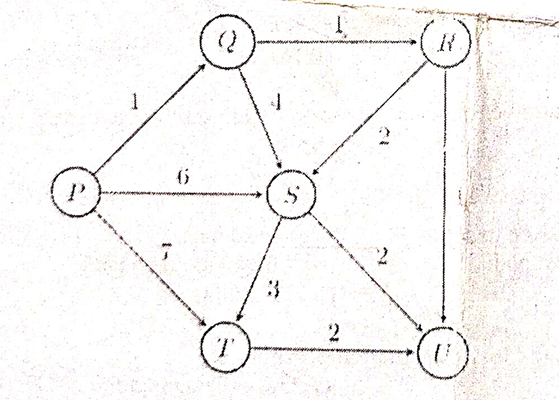20247m
Module 4: Graph and Tree Algorithms
View this question on its own page →Apply single source shortest path algorithm for the following graph

Q8e. Explain the max-flow min-cut theorem with an example.20236m
Module 4: Graph and Tree Algorithms
View this question on its own page →Explain the max-flow min-cut theorem with an example.
Q9b. Write short notes on: Topological sorting20247m
Module 4: Graph and Tree Algorithms
View this question on its own page →Write short notes on: Topological sorting