
2022 question paper
Design & Analysis of Algorithms
21 questions
Q1a. Any decision trees that sorts n elements has height: - (i) \Omega(\lg n) - (ii) \Omega(n) - (iii) \Omega(n \lg n) - (iv) \Omega(n^2)20222m
Module 1: Introduction and Complexity Analysis
View this question on its own page →Any decision trees that sorts elements has height:
- (i)
- (ii)
- (iii)
- (iv)
Q1b. Which of the following is an application of Queue Data Structure? - (i) When a resource is shared among multiple consumers - (ii) When data is transferred asynchronously (data not necessarily received at same rate as sent) between two processes - (iii) Load balancing - (iv) All of the above20222m
Module 1: Introduction and Complexity Analysis
View this question on its own page →Which of the following is an application of Queue Data Structure?
- (i) When a resource is shared among multiple consumers
- (ii) When data is transferred asynchronously (data not necessarily received at same rate as sent) between two processes
- (iii) Load balancing
- (iv) All of the above
Q1c. The complexity algorithm of binary search is: - (i) O(n) - (ii) O(\log n) - (iii) O(n^2) - (iv) O(n \log n)20222m
Module 2: Divide and Conquer Paradigm and Heaps
View this question on its own page →The complexity algorithm of binary search is:
- (i)
- (ii)
- (iii)
- (iv)
Q1d. In linear search algorithm the worst case occurs when: - (i) the item is somewhere in the middle of the array - (ii) the item is not in the array at all - (iii) the item is the last element in the array - (iv) the item is the last element in the array or is not there at all20222m
Module 1: Introduction and Complexity Analysis
View this question on its own page →In linear search algorithm the worst case occurs when:
- (i) the item is somewhere in the middle of the array
- (ii) the item is not in the array at all
- (iii) the item is the last element in the array
- (iv) the item is the last element in the array or is not there at all
Q1e. Given an unsorted array. The array has this property that every element in array is at most k distance from its position in sorted array where k is a positive integer smaller than size of array. Which sorting algorithm can be easily modified for sorting this array and what is the obtainable time complexity? - (i) Insertion sort with time complexity O(kn) - (ii) Heap sort with time complexity O(n \log k) - (iii) Quick sort with time complexity O(k \log k) - (iv) Merge sort with time complexity O(k \log k)20222m
Module 1: Introduction and Complexity Analysis
View this question on its own page →Given an unsorted array. The array has this property that every element in array is at most distance from its position in sorted array where is a positive integer smaller than size of array. Which sorting algorithm can be easily modified for sorting this array and what is the obtainable time complexity?
- (i) Insertion sort with time complexity
- (ii) Heap sort with time complexity
- (iii) Quick sort with time complexity
- (iv) Merge sort with time complexity
Q1f. Approach of dynamic programming is similar to: - (i) parsing - (ii) hash table - (iii) divide and conquer algorithm - (iv) greedy algorithm20222m
Module 3: Greedy, Dynamic Programming and Other Paradigms
View this question on its own page →Approach of dynamic programming is similar to:
- (i) parsing
- (ii) hash table
- (iii) divide and conquer algorithm
- (iv) greedy algorithm
Q1g. In the divide and conquer process, breaking the problem into smaller sub-problems is the responsibility of: - (i) divide/break - (ii) sorting/divide - (iii) conquer/solve - (iv) merge/combine20222m
Module 2: Divide and Conquer Paradigm and Heaps
View this question on its own page →In the divide and conquer process, breaking the problem into smaller sub-problems is the responsibility of:
- (i) divide/break
- (ii) sorting/divide
- (iii) conquer/solve
- (iv) merge/combine
Q1h. A priority queue is implemented as a Max-heap. Initially it has 5 elements. The level order traversal of the heap is 10, 8, 5, 3, 2. Two new elements '1' and '7' are inserted into the heap in that order. The level order traversal of the heap after the insertion of the elements is: - (i) 10, 8, 7, 5, 3, 2, 1 - (ii) 10, 8, 7, 2, 3, 1, 5 - (iii) 10, 8, 7, 1, 2, 3, 5 - (iv) 10, 8, 7, 3, 2, 1, 520222m
Module 2: Divide and Conquer Paradigm and Heaps
View this question on its own page →A priority queue is implemented as a Max-heap. Initially it has 5 elements. The level order traversal of the heap is 10, 8, 5, 3, 2. Two new elements '1' and '7' are inserted into the heap in that order. The level order traversal of the heap after the insertion of the elements is:
- (i) 10, 8, 7, 5, 3, 2, 1
- (ii) 10, 8, 7, 2, 3, 1, 5
- (iii) 10, 8, 7, 1, 2, 3, 5
- (iv) 10, 8, 7, 3, 2, 1, 5
Q1i. If a problem can be solved by combining optimal solutions to non-overlapping problems, the strategy is called: - (i) dynamic programming - (ii) greedy - (iii) divide and conquer - (iv) recursion20222m
Module 2: Divide and Conquer Paradigm and Heaps
View this question on its own page →If a problem can be solved by combining optimal solutions to non-overlapping problems, the strategy is called:
- (i) dynamic programming
- (ii) greedy
- (iii) divide and conquer
- (iv) recursion
Q1j. The choice of polynomial class has led to the development of an extensive theory called: - (i) computational complexity - (ii) time complexity - (iii) problem complexity - (iv) decision complexity20222m
Module 5: Tractable and Intractable Problems
View this question on its own page →The choice of polynomial class has led to the development of an extensive theory called:
- (i) computational complexity
- (ii) time complexity
- (iii) problem complexity
- (iv) decision complexity
- Install PocketlyBudget App•POCKETLY
Pocketly on Android
Log daily food, travel, and hostel expenses instantly. Set monthly spending limits and see where your money goes without complex spreadsheets.
Q2a. Calculate the time complexity of the following problem using divide and conquer strategies: (i) T(n) = \sqrt{n} \cdot T(\sqrt{n}) + n, \quad n > 2 (ii) T(n) = T(n-1) + 1/n, \quad n > 120227m
Module 1: Introduction and Complexity Analysis
View this question on its own page →Calculate the time complexity of the following problem using divide and conquer strategies:
(i)
(ii)Q2b. Write time function and calculate the time complexity, space complexity and number of function calls of the following pseudocode using substitution method: ``c rec(n) { if (n <= 1) return(1); else { rec(n / 2); for (i = 1; i <= n; i++) printf("algorithm"); } } ``20227m
Module 1: Introduction and Complexity Analysis
View this question on its own page →Write time function and calculate the time complexity, space complexity and number of function calls of the following pseudocode using substitution method:
rec(n) { if (n <= 1) return(1); else { rec(n / 2); for (i = 1; i <= n; i++) printf("algorithm"); } }Q3a. Explain the working of merge sort algorithm with an example. Give the complexity calculation of merge sort.20227m
Module 2: Divide and Conquer Paradigm and Heaps
View this question on its own page →Explain the working of merge sort algorithm with an example. Give the complexity calculation of merge sort.
Q3b. What are the rules of manipulate Big-Oh expression and about the typical growth rates of algorithms.20227m
Module 1: Introduction and Complexity Analysis
View this question on its own page →What are the rules of manipulate Big-Oh expression and about the typical growth rates of algorithms.
Q4a. What is heap sort? What is the effect of calling MAX-HEAPIFY(A, i) when the element A[i] is larger than its children?20227m
Module 2: Divide and Conquer Paradigm and Heaps
View this question on its own page →What is heap sort? What is the effect of calling
MAX-HEAPIFY(A, i)when the elementA[i]is larger than its children?Q4b. Explain how radix sort works, to what inputs it can be applied and what is its asymptotic complexity?20227m
Module 1: Introduction and Complexity Analysis
View this question on its own page →Explain how radix sort works, to what inputs it can be applied and what is its asymptotic complexity?
Q5. What do you mean by optimal solution in greedy approach? Define the properties and function of greedy approach. Consider the graph G=(V, E) given below. Find the minimum spanning tree by Prim's algorithms. 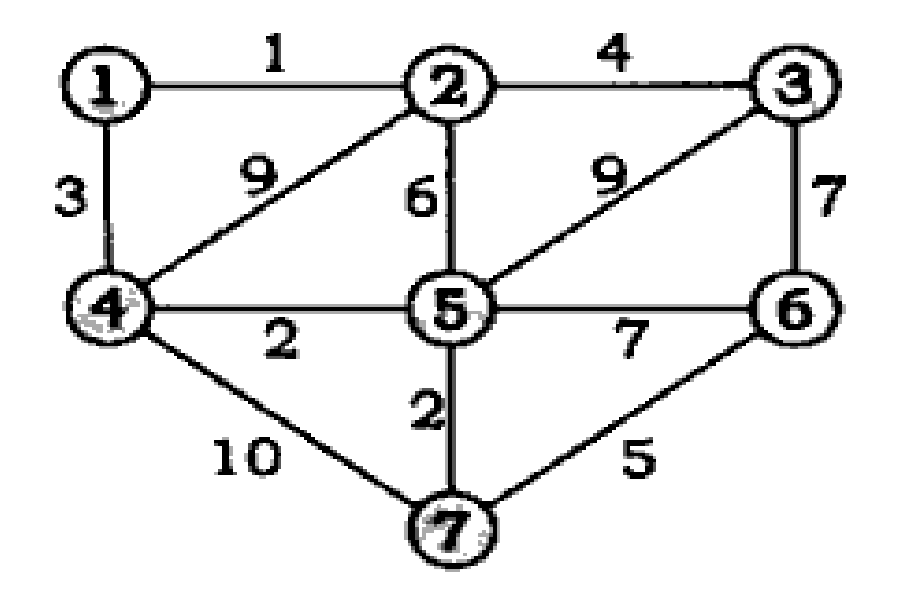202214m
Module 3: Greedy, Dynamic Programming and Other Paradigms
View this question on its own page →What do you mean by optimal solution in greedy approach? Define the properties and function of greedy approach. Consider the graph given below. Find the minimum spanning tree by Prim's algorithms.

Q6. Find the optimal way to multiply the following matrices to perform the fewest multiplications: | Matrix | Dimension | | :--- | :--- | | A_1 | 5 \times 11 | | A_2 | 11 \times 4 | | A_3 | 4 \times 15 | | A_4 | 15 \times 23 |202214m
Module 3: Greedy, Dynamic Programming and Other Paradigms
View this question on its own page →Find the optimal way to multiply the following matrices to perform the fewest multiplications:
Matrix Dimension Q7. You are given a graph containing n vertices and m edges and given that the graph doesn't contain cycle of odd length. What is the time complexity of the best known algorithm to find out whether the graph is bipartite or not?202214m
Module 4: Graph and Tree Algorithms
View this question on its own page →You are given a graph containing vertices and edges and given that the graph doesn't contain cycle of odd length. What is the time complexity of the best known algorithm to find out whether the graph is bipartite or not?
Q8. What is activity selection problem? Suppose that instead of always selecting the first activity to finish, we select the last activity to start that is compatible with all previously selected activities. Describe how this approach is a greedy algorithm, prove that it yields an optimal solution.202214m
Module 3: Greedy, Dynamic Programming and Other Paradigms
View this question on its own page →What is activity selection problem? Suppose that instead of always selecting the first activity to finish, we select the last activity to start that is compatible with all previously selected activities. Describe how this approach is a greedy algorithm, prove that it yields an optimal solution.
- Install PocketlyBudget App•POCKETLY
Pocketly on Android
Log daily food, travel, and hostel expenses instantly. Set monthly spending limits and see where your money goes without complex spreadsheets.
Q9b. Write short notes on: Approximation algorithms20227m
Module 5: Tractable and Intractable Problems
View this question on its own page →Write short notes on: Approximation algorithms
PYQDeck for Android
Solve BEU previous-year exam papers anywhere, anytime. Fast search, offline paper viewing, and step-by-step solutions designed specifically for your phone.