
Back to the 2025 paper
Similar questions
FORMAL LANGUAGE & AUTOMATA THEORYWhich of these represents a regular language? (i) \{ a^n b^n \mid n \ge 0 \} (ii) Strings with equal number of a’s and b’s (iii) \{ a^n \mid n \text{ is prime} \} (iv) \{ w \mid w \text{ starts with 'a' and ends with 'b'} \}20242m Compiler DesignChoose the correct option / answer the following: Which of the following is NOT accepted by finite automata? (i) Palindromes (ii) Strings with even number of a's (iii) Binary strings divisible by 3 (iv) Strings ending with 'ab'20242mFormal Language & Automata TheoryConsider the following finite state automaton: 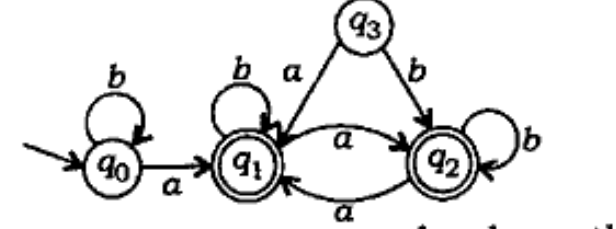 The language accepted by this automaton is given by the regular expression (i) b^*ab^*ab^*ab (ii) (a+b)^* (iii) b^*a(a+b)^* (iv) b^*ab^*ab20192mFormal Language & Automata TheoryThe language \{a^mb^nc^{m+n} \mid m, n \ge 1\} is (i) regular (ii) context-free but not regular (iii) context-sensitive but not context-free (iv) type-0 but not context-sensitive20212m
PreviousRegular languages belong to which type in the Chomsky hierarchy? (i) Type-0 (ii) Type-2 (iii) Type-1 (iv) Type-3NextContext-free languages are NOT closed under (i) Union (ii) Concatenation (iii) Intersection (iv) Kleene star
Official AppAndroid App
PYQDeck for Android
Solve BEU previous-year exam papers anywhere, anytime. Fast search, offline paper viewing, and step-by-step solutions designed specifically for your phone.