
Artificial intelligence
105501Module 2: Knowledge Representation and Reasoning
Q1d. Define satisfiability of a sentence.20192m
Module 2: Knowledge Representation and Reasoning
View this question on its own page →Define satisfiability of a sentence.
Q1e. Why does uncertainty arise?20192m
Module 2: Knowledge Representation and Reasoning
View this question on its own page →Why does uncertainty arise?
Q1e. What are not represented by using propositional logic? (i) Objects (ii) Relations (iii) Both objects and relations (iv) None of the above20202m
Module 2: Knowledge Representation and Reasoning
View this question on its own page →What are not represented by using propositional logic?
(i) Objects
(ii) Relations
(iii) Both objects and relations
(iv) None of the aboveQ1f. What is meant by belief network?20192m
Module 2: Knowledge Representation and Reasoning
View this question on its own page →What is meant by belief network?
Q1f. A knowledge-based agent can combine general knowledge with current percepts to infer hidden aspects of the current state prior to selecting actions. (i) True (ii) False20202m
Module 2: Knowledge Representation and Reasoning
View this question on its own page →A knowledge-based agent can combine general knowledge with current percepts to infer hidden aspects of the current state prior to selecting actions.
(i) True
(ii) FalseQ1g. Propositional logic cannot express which of the following? (i) True/false statements (ii) Compound statements (iii) Logical connectives (iv) Variables and functions20242m
Module 2: Knowledge Representation and Reasoning
View this question on its own page →Propositional logic cannot express which of the following?
(i) True/false statements
(ii) Compound statements
(iii) Logical connectives
(iv) Variables and functionsQ1g. Inference algorithm is completed only if (i) it can derive any sentence (ii) it can derive any sentence that is an entailed version (iii) it is truth preserving (iv) it can derive any sentence that is an entailed version and it is truth preserving20222m
Module 2: Knowledge Representation and Reasoning
View this question on its own page →Inference algorithm is completed only if
(i) it can derive any sentence
(ii) it can derive any sentence that is an entailed version
(iii) it is truth preserving
(iv) it can derive any sentence that is an entailed version and it is truth preservingQ1h. Bayesian networks are especially useful in situations with: (i) Complete knowledge and logic (ii) No uncertainty (iii) Deterministic processes (iv) Probabilistic and uncertain information20242m
Module 2: Knowledge Representation and Reasoning
View this question on its own page →Bayesian networks are especially useful in situations with:
(i) Complete knowledge and logic
(ii) No uncertainty
(iii) Deterministic processes
(iv) Probabilistic and uncertain informationQ1h. What are the two basic types of inference? (i) Reduction to propositional logic, manipulate rules directly (ii) Reduction to propositional logic, apply modus ponen (iii) Apply modus ponen, manipulate rules directly (iv) Convert every rule of horn clause, reduction to propositional logic20202m
Module 2: Knowledge Representation and Reasoning
View this question on its own page →What are the two basic types of inference?
(i) Reduction to propositional logic, manipulate rules directly
(ii) Reduction to propositional logic, apply modus ponen
(iii) Apply modus ponen, manipulate rules directly
(iv) Convert every rule of horn clause, reduction to propositional logicQ1i. What is an atomic event?20192m
Module 2: Knowledge Representation and Reasoning
View this question on its own page →What is an atomic event?
- Install PocketlyBudget App•POCKETLY
Pocketly on Android
Log daily food, travel, and hostel expenses instantly. Set monthly spending limits and see where your money goes without complex spreadsheets.
Q1i. Bayesian Networks are used to handle (i) Certain knowledge (ii) Uncertain knowledge (iii) Deterministic knowledge (iv) Syntax only20252m
Module 2: Knowledge Representation and Reasoning
View this question on its own page →Bayesian Networks are used to handle
(i) Certain knowledge
(ii) Uncertain knowledge
(iii) Deterministic knowledge
(iv) Syntax onlyQ1j. What is the need for utility theory in uncertainty?20192m
Module 2: Knowledge Representation and Reasoning
View this question on its own page →What is the need for utility theory in uncertainty?
Q1j. Graph used to represent semantic network is (i) undirected graph (ii) directed graph (iii) directed acyclic graph (DAG) (iv) directed complete graph20222m
Module 2: Knowledge Representation and Reasoning
View this question on its own page →Graph used to represent semantic network is
(i) undirected graph
(ii) directed graph
(iii) directed acyclic graph (DAG)
(iv) directed complete graphQ3a. What are the steps to convert first order logic or predicate logic sentence to normal form. Explain each step.20197m
Module 2: Knowledge Representation and Reasoning
View this question on its own page →What are the steps to convert first order logic or predicate logic sentence to normal form. Explain each step.
Q3b. Draw the semantic network of the following sentence: Kavita gives a book to her friend.20207m
Module 2: Knowledge Representation and Reasoning
View this question on its own page →Draw the semantic network of the following sentence:
Kavita gives a book to her friend.
Q4a. Consider this knowledge-base (KB) for an instance of the Blocks World problem : 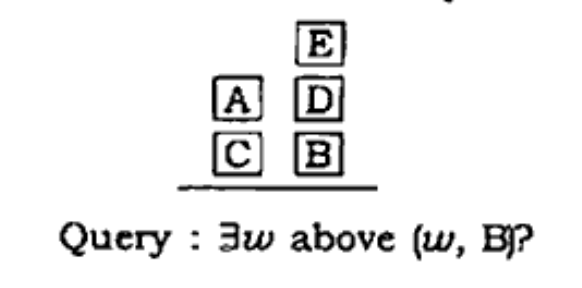 Query : \exists w above (w, B)? KB for Blocks World problem : 1. on (A, C) 2. on (D, B)20197m
Module 2: Knowledge Representation and Reasoning
View this question on its own page →Consider this knowledge-base (KB) for an instance of the Blocks World problem :

Query : above ?
KB for Blocks World problem :
- on (A, C)
- on (D, B)
Q4b. Consider the knowledge-base (KB) for the Blocks World problem from the previous question. Draw the complete AND-OR proof tree showing all the answers to the query ∃w above(w, B).20197m
Module 2: Knowledge Representation and Reasoning
View this question on its own page →Consider the knowledge-base (KB) for the Blocks World problem from the previous question.
Draw the complete AND-OR proof tree showing all the answers to the query ∃w above(w, B).
Q5a. Define prior probability and conditional probability. State Bayes's theorem. How is it useful for decision making under uncertainty?20197m
Module 2: Knowledge Representation and Reasoning
View this question on its own page →Define prior probability and conditional probability. State Bayes's theorem. How is it useful for decision making under uncertainty?
Q5b. Explain logics for non-monotonic reasoning.20197m
Module 2: Knowledge Representation and Reasoning
View this question on its own page →Explain logics for non-monotonic reasoning.
Q5b. Compare probabilistic reasoning using Bayesian Networks with logical reasoning. In what situations is probabilistic reasoning more appropriate? Give examples.20247m
Module 2: Knowledge Representation and Reasoning
View this question on its own page →Compare probabilistic reasoning using Bayesian Networks with logical reasoning. In what situations is probabilistic reasoning more appropriate? Give examples.
- Install PocketlyBudget App•POCKETLY
Pocketly on Android
Log daily food, travel, and hostel expenses instantly. Set monthly spending limits and see where your money goes without complex spreadsheets.
Q5b. What is First Order Predicate Logic (FOPL)? Represent the following facts in FOPL: "Anyone passing his AI paper and getting an opportunity to work on live project is Happy. But anyone who studies sincerely or is Lucky can pass all his exams. Ramu did not study but he is Lucky. Anyone who is Lucky gets a live project to work."20207m
Module 2: Knowledge Representation and Reasoning
View this question on its own page →What is First Order Predicate Logic (FOPL)? Represent the following facts in FOPL:
"Anyone passing his AI paper and getting an opportunity to work on live project is Happy. But anyone who studies sincerely or is Lucky can pass all his exams. Ramu did not study but he is Lucky. Anyone who is Lucky gets a live project to work."
Q6a. Write down the difference between Forward reasoning and Backward reasoning.20197m
Module 2: Knowledge Representation and Reasoning
View this question on its own page →Write down the difference between Forward reasoning and Backward reasoning.
Q6a. What is partial-order planning? Explain with a block-world example, showing how actions can be arranged without a strict linear order.20247m
Module 2: Knowledge Representation and Reasoning
View this question on its own page →What is partial-order planning? Explain with a block-world example, showing how actions can be arranged without a strict linear order.
Q6a. Write short notes on the following: Knowledge20203.5m
Module 2: Knowledge Representation and Reasoning
View this question on its own page →Write short notes on the following:
Knowledge
Q6a. What is fuzzy set? What is the difference between fuzzy set and crisp set? Explain different fuzzy set operations using examples.20227m
Module 2: Knowledge Representation and Reasoning
View this question on its own page →What is fuzzy set? What is the difference between fuzzy set and crisp set? Explain different fuzzy set operations using examples.
Q6b. Discuss the role of Probabilistic reasoning in handling uncertainty.20197m
Module 2: Knowledge Representation and Reasoning
View this question on its own page →Discuss the role of Probabilistic reasoning in handling uncertainty.
Q6b. Explain resolution in First-Order Logic (FOL). Using a simple knowledge base (e.g., "All humans are mortal, Socrates is a human"), derive a conclusion using resolution refutation.20247m
Module 2: Knowledge Representation and Reasoning
View this question on its own page →Explain resolution in First-Order Logic (FOL). Using a simple knowledge base (e.g., "All humans are mortal, Socrates is a human"), derive a conclusion using resolution refutation.
Q6b. Write a Prolog program that verified whether an input list is a palindrome. Hint: Goal : Palindrome ([r, a, c, e, c, a, r]) Output : Yes Goal : Palindrome ([a, b, c]) Output : No20227m
Module 2: Knowledge Representation and Reasoning
View this question on its own page →Write a Prolog program that verified whether an input list is a palindrome.
Hint:
Goal : Palindrome ([r, a, c, e, c, a, r])
Output : Yes
Goal : Palindrome ([a, b, c])
Output : NoQ6c. Write short notes on the following: Inheritance knowledge20203.5m
Module 2: Knowledge Representation and Reasoning
View this question on its own page →Write short notes on the following:
Inheritance knowledge
Q6d. Write short notes on the following: Knowledge management20203.5m
Module 2: Knowledge Representation and Reasoning
View this question on its own page →Write short notes on the following:
Knowledge management
- Install PocketlyBudget App•POCKETLY
Pocketly on Android
Log daily food, travel, and hostel expenses instantly. Set monthly spending limits and see where your money goes without complex spreadsheets.
Q7a. Explain Bayesian Networks and their role in handling uncertainty.20257m
Module 2: Knowledge Representation and Reasoning
View this question on its own page →Explain Bayesian Networks and their role in handling uncertainty.
Q7b. Convert the following statements into First Order Logic: "All men are mortal. Socrates is a man."20257m
Module 2: Knowledge Representation and Reasoning
View this question on its own page →Convert the following statements into First Order Logic: "All men are mortal. Socrates is a man."
Q8a. Differentiate between forward chaining and backward chaining. On what factors does the decision to choose forward or backward chaining depend?20207m
Module 2: Knowledge Representation and Reasoning
View this question on its own page →Differentiate between forward chaining and backward chaining. On what factors does the decision to choose forward or backward chaining depend?
Q8b. Explain Semantic network with suitable example.20197m
Module 2: Knowledge Representation and Reasoning
View this question on its own page →Explain Semantic network with suitable example.
Q8b. Consider the following sentences: * John likes all kinds of food. * Apples are food. * Chicken is food. * Anything anyone eats and isn't killed by it, is food. * Sue eats everything Bill eats. (i) Translate the sentences into formulae in predicate logic. Prove that John likes peanuts using backward chaining. (ii) Convert the formulae of part (i) into clause form. (iii) Prove that John likes peanuts using resolution. (iv) Use resolution to answer the question, "What food does Sue eat?"20207m
Module 2: Knowledge Representation and Reasoning
View this question on its own page →Consider the following sentences:
- John likes all kinds of food.
- Apples are food.
- Chicken is food.
- Anything anyone eats and isn't killed by it, is food.
- Sue eats everything Bill eats.
(i) Translate the sentences into formulae in predicate logic. Prove that John likes peanuts using backward chaining.
(ii) Convert the formulae of part (i) into clause form.
(iii) Prove that John likes peanuts using resolution.
(iv) Use resolution to answer the question, "What food does Sue eat?"Q9b. Define prior probability and conditional probability. State Bayes's theorem. How is it useful for decision making under uncertainty.20227m
Module 2: Knowledge Representation and Reasoning
View this question on its own page →Define prior probability and conditional probability. State Bayes's theorem. How is it useful for decision making under uncertainty.