
2019 question paper
Formal Language & Automata Theory
23 questions
Q1a. Consider the following finite state automaton: 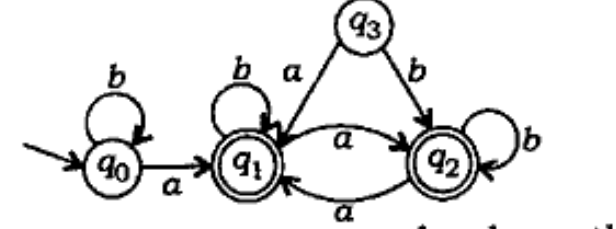 The language accepted by this automaton is given by the regular expression (i) b^*ab^*ab^*ab (ii) (a+b)^* (iii) b^*a(a+b)^* (iv) b^*ab^*ab20192m
Module 1: Introduction, Regular languages and finite automata
View this question on its own page →Consider the following finite state automaton:

The language accepted by this automaton is given by the regular expression
(i)
(ii)
(iii)
(iv)Q1c. A minimum state deterministic finite automaton accepting the language L = \{w \mid w \in \{0, 1\}^*, \text{ number of 0's and 1's in } w \text{ are divisible by 3 and 5 respectively}\} has (i) 15 states (ii) 11 states (iii) 10 states (iv) 9 states20192m
Module 1: Introduction, Regular languages and finite automata
View this question on its own page →A minimum state deterministic finite automaton accepting the language
has
(i) 15 states
(ii) 11 states
(iii) 10 states
(iv) 9 statesQ1d. Consider the following languages: GATE[2005] L_1 = \{ww^R \mid w \in \{0, 1\}^*\} L_2 = \{w\#w^R \mid w \in \{0, 1\}^*\} where \# is a special symbol, L_3 = \{ww \mid w \in \{0, 1\}^*\} Which one of the following is true? (i) L_1 is a deterministic CFL (ii) L_2 is a deterministic CFL (iii) L_3 is a CFL, but not a deterministic CFL (iv) L_3 is a deterministic CFL20192m
Module 2: Context-free languages and pushdown automata
View this question on its own page →Consider the following languages:
GATE[2005]
where is a special symbol,Which one of the following is true?
(i) is a deterministic CFL
(ii) is a deterministic CFL
(iii) is a CFL, but not a deterministic CFL
(iv) is a deterministic CFLQ1e. Consider the following statements about the context-free grammar: (1) G = \{S \to SS, S \to ab, S \to ba, S \to \epsilon\} (2) G is ambiguous (3) G produces all strings with equal number of a's and b's G can be accepted by a deterministic PDA. Which combination below expresses all the true statements about G? (i) 1 only (ii) 1 and 3 (iii) 2 and 3 (iv) 1, 2 and 320192m
Module 2: Context-free languages and pushdown automata
View this question on its own page →Consider the following statements about the context-free grammar:
(1)
(2) is ambiguous
(3) produces all strings with equal number of 's and 'scan be accepted by a deterministic PDA. Which combination below expresses all the true statements about ?
(i) 1 only
(ii) 1 and 3
(iii) 2 and 3
(iv) 1, 2 and 3Q1f. Consider the grammar G whose SLR parser has n_1 states and LALR parser has n_2 states. What is the relation between n_1 and n_2? (i) n_1 = n_2 (ii) n_1 < n_2 (iii) n_1 > n_2 (iv) None of the above20192m
Module 2: Context-free languages and pushdown automata
View this question on its own page →Consider the grammar whose SLR parser has states and LALR parser has states. What is the relation between and ?
(i)
(ii)
(iii)
(iv) None of the aboveQ1g. Let w be any string of length n in \{0, 1\}^*. Let L be the set of all substrings of w. What is the minimum number of states in a non-deterministic FA that accepts L? (i) n - 1 (ii) n (iii) n + 1 (iv) 2n - 120192m
Module 1: Introduction, Regular languages and finite automata
View this question on its own page →Let be any string of length in . Let be the set of all substrings of . What is the minimum number of states in a non-deterministic FA that accepts ?
(i)
(ii)
(iii)
(iv)Q1h. Consider the regular expression (0+1)(0+1)\dots N \text{ times}. The minimum state FA that recognizes the language represented by this regular expression contains (i) n states (ii) (n+1) states (iii) (n+2) states (iv) None of the above20192m
Module 1: Introduction, Regular languages and finite automata
View this question on its own page →Consider the regular expression . The minimum state FA that recognizes the language represented by this regular expression contains
(i) states
(ii) states
(iii) states
(iv) None of the aboveQ1i. In Mealy machine, output is a function of (i) present state only (ii) next state only (iii) present state and input (iv) input only20192m
Module 1: Introduction, Regular languages and finite automata
View this question on its own page →In Mealy machine, output is a function of
(i) present state only
(ii) next state only
(iii) present state and input
(iv) input onlyQ1j. Let N be an NFA with n states and let M be the minimized DFA with m states recognizing the same language. Which of the following is necessarily true? (i) m \le 2^n (ii) n \le m (iii) M has one accept state (iv) m = 2n20192m
Module 1: Introduction, Regular languages and finite automata
View this question on its own page →Let be an NFA with states and let be the minimized DFA with states recognizing the same language. Which of the following is necessarily true?
(i)
(ii)
(iii) has one accept state
(iv)Q2a. Design deterministic finite automata for the set of strings over the alphabet \{a, b\} containing at least three occurrences of three consecutive b's, overlapping permitted (e.g., the string bbbbb should be accepted).20197m
Module 1: Introduction, Regular languages and finite automata
View this question on its own page →Design deterministic finite automata for the set of strings over the alphabet containing at least three occurrences of three consecutive 's, overlapping permitted (e.g., the string should be accepted).
- Install PocketlyBudget App•POCKETLY
Pocketly on Android
Log daily food, travel, and hostel expenses instantly. Set monthly spending limits and see where your money goes without complex spreadsheets.
Q2b. Let \Sigma = \{0, 1\}. Let L be the language that consists of strings having either 01 repeated one or more times or 010 repeated one or more times. Is L regular? Explain.20197m
Module 1: Introduction, Regular languages and finite automata
View this question on its own page →Let . Let be the language that consists of strings having either repeated one or more times or repeated one or more times. Is regular? Explain.
Q3a. Assume that a regular language L is provided to you as a DFA M(\{Q, \Sigma, \delta, q_0, F\}). How would you check whether L is infinite?20197m
Module 1: Introduction, Regular languages and finite automata
View this question on its own page →Assume that a regular language is provided to you as a DFA . How would you check whether is infinite?
Q3b. Design a push-down automata for accepting the string for the language L = \{WW^R \mid W \in \{a, b\}^*\} by the empty stack as well as final state.20197m
Module 2: Context-free languages and pushdown automata
View this question on its own page →Design a push-down automata for accepting the string for the language by the empty stack as well as final state.
Q4a. Construct a Moore machine which determines the residue mod 3 for each binary string treated as binary integer. And then convert into the corresponding Mealy machine.20197m
Module 1: Introduction, Regular languages and finite automata
View this question on its own page →Construct a Moore machine which determines the residue mod 3 for each binary string treated as binary integer. And then convert into the corresponding Mealy machine.
Q4b. Design finite state machine or abstract model for binary adder.20197m
Module 1: Introduction, Regular languages and finite automata
View this question on its own page →Design finite state machine or abstract model for binary adder.
Q5a. Prove that the language L = \{a^{i^2} \mid i \ge 1\} is not context-free language.20197m
Module 2: Context-free languages and pushdown automata
View this question on its own page →Prove that the language is not context-free language.
Q5b. Show that L = \text{palindrome over } \{a, b\} is not regular.20197m
Module 1: Introduction, Regular languages and finite automata
View this question on its own page →Show that is not regular.
Q6a. Consider the following language: L = \{a^m b^{2n} c^{3n} d^p \mid p > m \text{ and } m, n \ge 1\} Write a context-free grammar to generate L and write shortest string in L.20197m
Module 2: Context-free languages and pushdown automata
View this question on its own page →Consider the following language:
Write a context-free grammar to generate and write shortest string in .
Q6b. Convert the following context-free grammar into GNF: S \to XY X \to YS \mid b Y \to SX \mid a20197m
Module 2: Context-free languages and pushdown automata
View this question on its own page →Convert the following context-free grammar into GNF:
Q7a. Construct a push-down automata that accepts the following language: L = \{uawb \mid u \text{ and } w \in \{a, b\}^* \text{ and } |u| = |w|\}20197m
Module 2: Context-free languages and pushdown automata
View this question on its own page →Construct a push-down automata that accepts the following language:
- Install PocketlyBudget App•POCKETLY
Pocketly on Android
Log daily food, travel, and hostel expenses instantly. Set monthly spending limits and see where your money goes without complex spreadsheets.
Q7b. Using the following grammar S \to AB \mid BC A \to BA \mid a B \to CC \mid b C \to AB \mid a use the CYK algorithm to determine whether the given string baaba is in L(G) or not.20197m
Module 2: Context-free languages and pushdown automata
View this question on its own page →Using the following grammar
use the CYK algorithm to determine whether the given string is in or not.
Q8a. Design a Turing machine to perform 2's compliment operation on binary string.20197m
Module 4: Turing machines
View this question on its own page →Design a Turing machine to perform 2's compliment operation on binary string.
Q8b. Write short notes on the following: (i) Deterministic PDA vs. non-deterministic PDA (ii) Universal Turing machine (iii) Non-deterministic Turing machine (iv) Post correspondence problem (PCP)20197m
Module 5: Undecidability
View this question on its own page →Write short notes on the following:
(i) Deterministic PDA vs. non-deterministic PDA
(ii) Universal Turing machine
(iii) Non-deterministic Turing machine
(iv) Post correspondence problem (PCP)
Pocketly on Android
Log daily food, travel, and hostel expenses instantly. Set monthly spending limits and see where your money goes without complex spreadsheets.