
Back to the 2023 paper
Similar questions
Design & Analysis of AlgorithmsWrite short notes on: Branch and bound technique20197mArtificial intelligenceDifferentiate between forward chaining and backward chaining. On what factors does the decision to choose forward or backward chaining depend?20207mDesign & Analysis of AlgorithmsExplain back-tracking, DFS and BFS with help of small example. Differentiate in between backtracking and dynamic programming. Apply the backtracking algorithm to solve the three-colouring problem for the following graph using state space tree. Assume three colours red, green and blue. 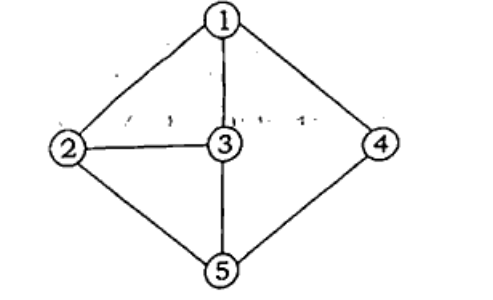201914mDesign and Analysis of Algorithms Differentiate between divide & conquer, greedy method and dynamic programming with suitable examples.20227m
PreviousApply the backtracking approach and find the Hamiltonian cycle for the graph given in the form of matrix. Show all the steps to find the cycle. | | A | B | C | D | E | F | |---|---|---|---|---|---|---| | A | 0 | 1 | 1 | 0 | 0 | 1 | | B | 1 | 0 | 1 | 1 | 0 | 0 | | C | 1 | 1 | 0 | 0 | 1 | 0 | | D | 0 | 1 | 0 | 0 | 1 | 0 | | E | 0 | 0 | 1 | 1 | 0 | 1 | | F | 1 | 0 | 1 | 0 | 1 | 0 |NextIn the below given weighted graph W (Given in form of matrix), apply Bellman Ford's algorithm to find the shortest distances from source node 3. Write the time complexity of Bellman Ford's algorithm. | | 1 | 2 | 3 | 4 | 5 | |---|---|---|---|---|---| | 1 | 0 | 1 | 8 | 1 | 4 | | 2 | 1 | 0 | 12 | 4 | 9 | | 3 | 8 | 12 | 0 | 7 | 3 | | 4 | 1 | 4 | 7 | 0 | 2 | | 5 | 4 | 9 | 3 | 2 | 0 |
Official AppAndroid App
PYQDeck for Android
Solve BEU previous-year exam papers anywhere, anytime. Fast search, offline paper viewing, and step-by-step solutions designed specifically for your phone.