
Back to the 2024 paper
Similar questions
Design & Analysis of AlgorithmsExplain back-tracking, DFS and BFS with help of small example. Differentiate in between backtracking and dynamic programming. Apply the backtracking algorithm to solve the three-colouring problem for the following graph using state space tree. Assume three colours red, green and blue. 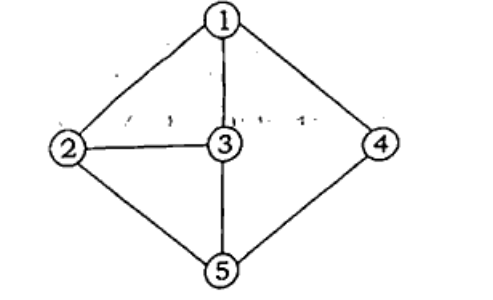201914mDesign and Analysis of Algorithms Consider a TSP with 4 cities A, B, C, D and the following distance matrix: | | A | B | C | D | |---|---|---|---|---| | A | 0 | 10 | 15 | 20 | | B | 10 | 0 | 35 | 25 | | C | 15 | 35 | 0 | 30 | | D | 20 | 25 | 30 | 0 | Answer the following: (i) Use the branch-and-bound algorithm to find the shortest possible route that visits all cities exactly once and returns to the starting city. (ii) Show the branching steps and calculate lower bounds for each partial solution. (iii) Identify how the bounding helps prune the search tree.20247mDesign and Analysis of Algorithms Answer the following: (i) Compare and contrast the BFS and DFS traversal techniques in terms of their algorithmic approach, time complexity, data structures used, and typical applications. (ii) Give examples where one is preferred over the other.20247mDesign and Analysis of Algorithms Write the Pseudo-code for the Dijkstra's Algorithm. Further, find the single source (A) shortest path on the following graph: 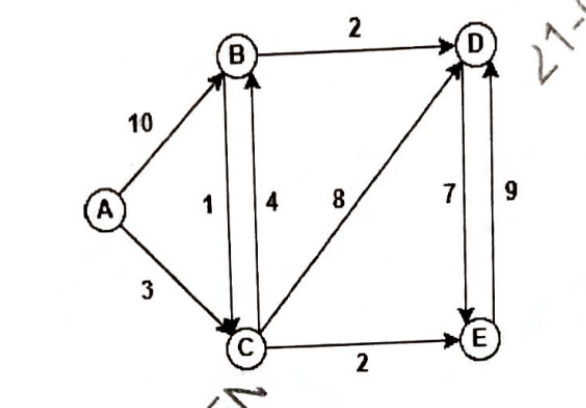20247m
PreviousDesign a system that finds the shortest paths between various locations in a city. The locations and roads are represented using a graph. What algorithm would you use if: (i) All roads have equal length (ii) Roads have varying lengths, but no negative lengths (iii) Some roads have negative lengths Justify your choices with suitable algorithms and reasoning.NextWrite the Pseudo-code for the Dijkstra's Algorithm. Further, find the single source (A) shortest path on the following graph: 
Budget AppAndroid App
Pocketly on Android
Log daily food, travel, and hostel expenses instantly. Set monthly spending limits and see where your money goes without complex spreadsheets.