
Back to the 2024 paper
Similar questions
Design and Analysis of Algorithms What is minimum spanning tree (MST)? Explain the steps of Prim's algorithm to find the MST using an example.20237mDesign & Analysis of AlgorithmsWrite an algorithm to find a minimum spanning tree (MST) for an undirected graph. Estimate the time complexity of your algorithm.20238mDesign and Analysis of Algorithms What is a Minimum Cost Spanning tree? Explain Kruskal's Minimum cost spanning tree algorithm with a suitable example.20257mDesign and Analysis of Algorithms Which algorithm is used to find a Minimum Spanning Tree? (i) Dijkstra's algorithm (ii) Prim's algorithm (iii) Bellman-Ford algorithm (iv) Floyd-Warshall algorithm20242m
PreviousWrite the Pseudo-code for the Dijkstra's Algorithm. Further, find the single source (A) shortest path on the following graph: 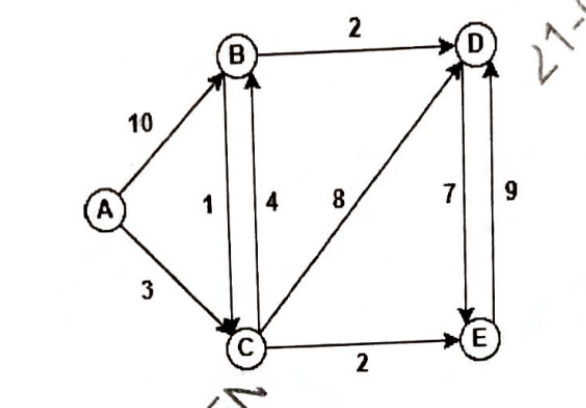NextGiven the flow network below with capacities: | EDGE | CAPACITY | |---|---| | S -> A | 10 | | S -> C | 10 | | A -> B | 4 | | A -> C | 2 | | C -> D | 9 | | B -> T | 10 | | D -> B | 6 | | D -> T | 10 | Answer the following: (i) Use the Ford-Fulkerson algorithm to find the maximum flow from source (S) to sink (T). (ii) Show the augmenting paths selected, the bottleneck capacities on each path, and the updated residual capacities after each augmentation. (iii) Calculate the final maximum flow value.
Official AppAndroid App
PYQDeck for Android
Solve BEU previous-year exam papers anywhere, anytime. Fast search, offline paper viewing, and step-by-step solutions designed specifically for your phone.