
Back to the 2022 paper
Similar questions
Formal Language & Automata TheoryLet L = \{w \mid w \in \{0+1\}^*, w \text{ has even number of 1s}\}. Which one of the regular expression below represents L? (i) (0^* 10^* 1)^* (ii) 0^*(10^* 10^*)^* (iii) 0^* (10^* 1^*)^* 0^* (iv) 0^* 1(10^* 1)^* 10^*20202mFormal Language & Automata TheoryWhich of the following requires context sensitivity? (i) a^n b^n (ii) a^n b^n c^n (iii) (a+b)^* (iv) a^*20252mFormal Language & Automata TheoryConsider the following finite state automaton: 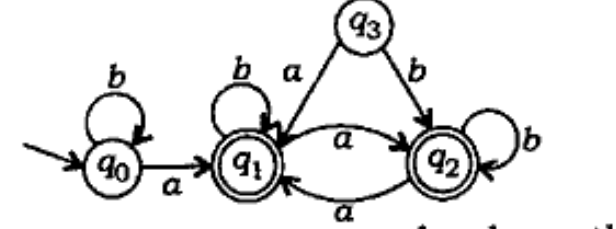 The language accepted by this automaton is given by the regular expression (i) b^*ab^*ab^*ab (ii) (a+b)^* (iii) b^*a(a+b)^* (iv) b^*ab^*ab20192mDiscrete MathematicsWhich of the following two sets are equal? (i) A = \{1, 2\} and B = \{1\} (ii) A = \{1, 2\} and B = \{1, 2, 3\} (iii) A = \{1, 2, 3\} and B = \{2, 1, 3\} (iv) A = \{1, 2, 4\} and B = \{1, 2, 3\}20222m
Previous___________ is the acyclic graphical representation of a grammar (i) Binary tree (ii) Octtree (iii) Parse tree (iv) None of the aboveNextThe maximum number of states of a DFA converted from an NFA with n states is (i) n (ii) n^2 (iii) 2^n (iv) None of these
Official AppAndroid App
PYQDeck for Android
Solve BEU previous-year exam papers anywhere, anytime. Fast search, offline paper viewing, and step-by-step solutions designed specifically for your phone.