
2022 question paper
Formal Language & Automata Theory
27 questions
Q1a. The language \{ a^m b^n c^{m+n} / m, n \ge 1 \} is (i) regular (ii) context-free but not regular (iii) Context-sensitive but not context free (iv) type-0 but not context sensitive20222m
Module 2: Context-free languages and pushdown automata
View this question on its own page →The language is
(i) regular
(ii) context-free but not regular
(iii) Context-sensitive but not context free
(iv) type-0 but not context sensitiveQ1b. Which of the following pairs have DIFFERENT expressive powers? (i) Deterministic finite automata (DFA) and non-deterministic finite automata (NDFA) (ii) Deterministic push-down automata (DPDA) and non-deterministic push-down automata (NDPDA) (iii) Deterministic single-tape Turing machine and non-deterministic single-tape Turing machine (iv) Single-tape Turing machine and multi-tape Turing machine20222m
Module 2: Context-free languages and pushdown automata
View this question on its own page →Which of the following pairs have DIFFERENT expressive powers?
(i) Deterministic finite automata (DFA) and non-deterministic finite automata (NDFA)
(ii) Deterministic push-down automata (DPDA) and non-deterministic push-down automata (NDPDA)
(iii) Deterministic single-tape Turing machine and non-deterministic single-tape Turing machine
(iv) Single-tape Turing machine and multi-tape Turing machineQ1c. The logic of pumping lemma is a good example of (i) pigeon-hole principle (ii) divide-and-conquer technique (iii) recursion (iv) iteration20222m
Module 1: Introduction, Regular languages and finite automata
View this question on its own page →The logic of pumping lemma is a good example of
(i) pigeon-hole principle
(ii) divide-and-conquer technique
(iii) recursion
(iv) iterationQ1d. If L1 and L2 are context free languages, L1 - L2 is ___________ context-free. (i) always (ii) sometimes (iii) never (iv) None of these20222m
Module 2: Context-free languages and pushdown automata
View this question on its own page →If and are context free languages, is ___________ context-free.
(i) always
(ii) sometimes
(iii) never
(iv) None of theseQ1e. ___________ is the acyclic graphical representation of a grammar (i) Binary tree (ii) Octtree (iii) Parse tree (iv) None of the above20222m
Module 2: Context-free languages and pushdown automata
View this question on its own page →___________ is the acyclic graphical representation of a grammar
(i) Binary tree
(ii) Octtree
(iii) Parse tree
(iv) None of the aboveQ1f. Which of the following pairs of regular expressions are equivalent? (i) x^* and x^*x (ii) 1(01)^* and (10)^*1 (iii) x(xx)^* and (xx)^*x (iv) All of the above20222m
Module 1: Introduction, Regular languages and finite automata
View this question on its own page →Which of the following pairs of regular expressions are equivalent?
(i) and
(ii) and
(iii) and
(iv) All of the aboveQ1g. The maximum number of states of a DFA converted from an NFA with n states is (i) n (ii) n^2 (iii) 2^n (iv) None of these20222m
Module 1: Introduction, Regular languages and finite automata
View this question on its own page →The maximum number of states of a DFA converted from an NFA with states is
(i)
(ii)
(iii)
(iv) None of theseQ1h. Definition of a language L with alphabet \{a\} is given as L= \{a^{nk} / k > 0, \text{ and } n \text{ is a positive integer constant}\}. What is the minimum number of states needed in a DFA to recognize L? (i) k + 1 (ii) n + 1 (iii) 2n + 1 (iv) 2k + 120222m
Module 1: Introduction, Regular languages and finite automata
View this question on its own page →Definition of a language with alphabet is given as . What is the minimum number of states needed in a DFA to recognize L?
(i)
(ii)
(iii)
(iv)Q1i. A ___________ is context free grammar with atmost one non-terminal in the right handside of the production. (i) linear grammar (ii) linear bounded grammar (iii) regular grammar (iv) None of the above20222m
Module 2: Context-free languages and pushdown automata
View this question on its own page →A ___________ is context free grammar with atmost one non-terminal in the right handside of the production.
(i) linear grammar
(ii) linear bounded grammar
(iii) regular grammar
(iv) None of the aboveQ1j. Let N be an NFA with n states and let M be the minimized DFA with m states recognizing the same language. Which of the following is necessarily true? (i) m \le 2^n (ii) n \le m (iii) M has one accept state (iv) m = 2^n20222m
Module 1: Introduction, Regular languages and finite automata
View this question on its own page →Let be an NFA with states and let be the minimized DFA with states recognizing the same language. Which of the following is necessarily true?
(i)
(ii)
(iii) has one accept state
(iv)- Install PocketlyBudget App•POCKETLY
Pocketly on Android
Log daily food, travel, and hostel expenses instantly. Set monthly spending limits and see where your money goes without complex spreadsheets.
Q2a. Tabulate Chomsky hierarchy of grammars with an example for each.20227m
Module 1: Introduction, Regular languages and finite automata
View this question on its own page →Tabulate Chomsky hierarchy of grammars with an example for each.
Q2b. Construct the regular grammar accepting the following language: L = \{ w \in \{a, b\}^* / w \text{ is a string over } \{a, b\} \text{ such that the number of b's is } 3 \pmod 4 \}20227m
Module 1: Introduction, Regular languages and finite automata
View this question on its own page →Construct the regular grammar accepting the following language:
Q3a. Minimize the DFA shown in the following transition diagram: 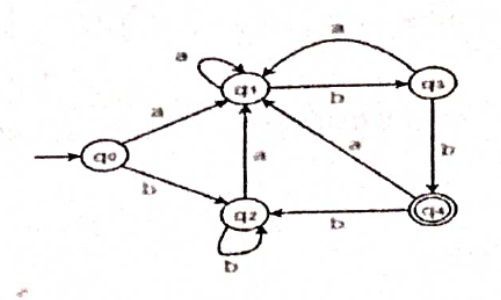20227m
Module 1: Introduction, Regular languages and finite automata
View this question on its own page →Minimize the DFA shown in the following transition diagram:

Q3b. Define recursively enumerable languages. Let L_1 be recursive and L_2 recursively enumerable. Show that L_2 - L_1 is necessarily recursively enumerable.20227m
Module 4: Turing machines
View this question on its own page →Define recursively enumerable languages. Let be recursive and recursively enumerable. Show that is necessarily recursively enumerable.
Q4. Begin with the grammar: S \to ASB / \epsilon A \to aAS / a B \to SbS / A / bb (i) Eliminate \epsilon-productions. (ii) Eliminate unit productions in the resulting grammar. (iii) Eliminate any useless symbol in the resulting grammar. (iv) Put the resulting grammar into CNF.202214m
Module 2: Context-free languages and pushdown automata
View this question on its own page →Begin with the grammar:
(i) Eliminate -productions.
(ii) Eliminate unit productions in the resulting grammar.
(iii) Eliminate any useless symbol in the resulting grammar.
(iv) Put the resulting grammar into CNF.Q5a. Design a pushdown automata to accept the following language by empty stack: \{ 0^n 1^n / n \ge 1 \}.20227m
Module 2: Context-free languages and pushdown automata
View this question on its own page →Design a pushdown automata to accept the following language by empty stack: .
Q5b. Define deterministic pushdown automata. Explain with an example.20227m
Module 2: Context-free languages and pushdown automata
View this question on its own page →Define deterministic pushdown automata. Explain with an example.
Q6a. Prove using pumping lemma for regular languages that the language \{ 0^n / n \text{ is a perfect square} \} is not regular.20227m
Module 1: Introduction, Regular languages and finite automata
View this question on its own page →Prove using pumping lemma for regular languages that the language is not regular.
Q6b. Convert the following DFA to regular expression using the state elimination technique. | State/input | 0 | 1 | |---|---|---| | \to *p | s | p | | q | p | s | | r | r | q | | s | q | r |20227m
Module 1: Introduction, Regular languages and finite automata
View this question on its own page →Convert the following DFA to regular expression using the state elimination technique.
State/input 0 1 s p q p s r r q s q r Q7a. Convert the following NFA to DFA and informally describe the language it accepts. | State/input | 0 | 1 | |---|---|---| | \to p | {p, q} | {p} | | q | {r, s} | {t} | | r | {p, r} | {t} | | *s | \emptyset | \emptyset | | *t | \emptyset | \emptyset |20227m
Module 1: Introduction, Regular languages and finite automata
View this question on its own page →Convert the following NFA to DFA and informally describe the language it accepts.
State/input 0 1 {p, q} {p} q {r, s} {t} r {p, r} {t} *s *t - Install PocketlyBudget App•POCKETLY
Pocketly on Android
Log daily food, travel, and hostel expenses instantly. Set monthly spending limits and see where your money goes without complex spreadsheets.
Q7b. When a CFG is called ambiguous? Show that S \to as / aSbS / \epsilon is ambiguous.20227m
Module 2: Context-free languages and pushdown automata
View this question on its own page →When a CFG is called ambiguous? Show that is ambiguous.
Q8a. Define Turing machine. Design a Turing machine M to recognize the language \{ 1^n 2^n 3^n / n \ge 1 \}.20227m
Module 4: Turing machines
View this question on its own page →Define Turing machine. Design a Turing machine to recognize the language .
Q8b. Construct DFA equivalent to the regular expression: (0+1)^* (00+11) (0+1)^*20227m
Module 1: Introduction, Regular languages and finite automata
View this question on its own page →Construct DFA equivalent to the regular expression:
Q9i. Write short notes on: Pumping lemma for CFL20227m
Module 2: Context-free languages and pushdown automata
View this question on its own page →Write short notes on: Pumping lemma for CFL
Q9ii. Write short notes on: GNF20227m
Module 2: Context-free languages and pushdown automata
View this question on its own page →Write short notes on: GNF
Q9iii. Write short notes on: Multistack Turing Machine20227m
Module 4: Turing machines
View this question on its own page →Write short notes on: Multistack Turing Machine
Q9iv. Write short notes on: NP-hard problem20227m
PYQDeck for Android
Solve BEU previous-year exam papers anywhere, anytime. Fast search, offline paper viewing, and step-by-step solutions designed specifically for your phone.