
Formal Language & Automata Theory
105503Module 1: Introduction, Regular languages and finite automata
Q1a. Consider the following finite state automaton: 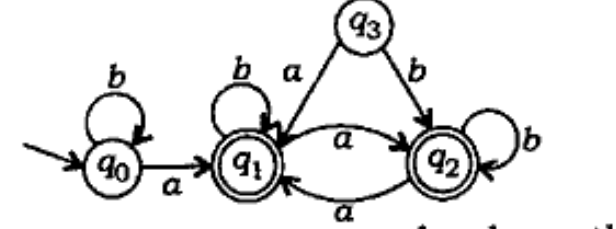 The language accepted by this automaton is given by the regular expression (i) b^*ab^*ab^*ab (ii) (a+b)^* (iii) b^*a(a+b)^* (iv) b^*ab^*ab20192m
Module 1: Introduction, Regular languages and finite automata
View this question on its own page →Consider the following finite state automaton:

The language accepted by this automaton is given by the regular expression
(i)
(ii)
(iii)
(iv)Q1a. Definition of a language L with alphabet \{a\} is given as L = \{a^{nk} \mid k > 0, \text{ and } n \text{ is a positive integer constant}\} What is the minimum number of states needed in a DFA to recognize L? (i) k + 1 (ii) n + 1 (iii) 2^{n + 1} (iv) 2^{k + 1}20202m
Module 1: Introduction, Regular languages and finite automata
View this question on its own page →Definition of a language with alphabet is given as
What is the minimum number of states needed in a DFA to recognize ?
(i)
(ii)
(iii)
(iv)Q1a. Which of the following is the smallest unit in the definition of a language? (i) Grammar (ii) Alphabet (iii) String (iv) Production20252m
Module 1: Introduction, Regular languages and finite automata
View this question on its own page →Which of the following is the smallest unit in the definition of a language?
(i) Grammar
(ii) Alphabet
(iii) String
(iv) ProductionQ1b. A language is a (i) Set of alphabets (ii) Set of strings over an alphabet (iii) Set of grammars (iv) Set of automata20252m
Module 1: Introduction, Regular languages and finite automata
View this question on its own page →A language is a
(i) Set of alphabets
(ii) Set of strings over an alphabet
(iii) Set of grammars
(iv) Set of automataQ1c. Which grammar type is the most powerful? (i) Type-0 (ii) Type-1 (iii) Type-2 (iv) Type-320252m
Module 1: Introduction, Regular languages and finite automata
View this question on its own page →Which grammar type is the most powerful?
(i) Type-0
(ii) Type-1
(iii) Type-2
(iv) Type-3Q1c. A minimum state deterministic finite automaton accepting the language L = \{w \mid w \in \{0, 1\}^*, \text{ number of 0's and 1's in } w \text{ are divisible by 3 and 5 respectively}\} has (i) 15 states (ii) 11 states (iii) 10 states (iv) 9 states20192m
Module 1: Introduction, Regular languages and finite automata
View this question on its own page →A minimum state deterministic finite automaton accepting the language
has
(i) 15 states
(ii) 11 states
(iii) 10 states
(iv) 9 statesQ1c. The logic of pumping lemma is a good example of (i) pigeon-hole principle (ii) divide-and-conquer technique (iii) recursion (iv) iteration20222m
Module 1: Introduction, Regular languages and finite automata
View this question on its own page →The logic of pumping lemma is a good example of
(i) pigeon-hole principle
(ii) divide-and-conquer technique
(iii) recursion
(iv) iterationQ1d. Epsilon (\varepsilon) transitions are allowed in (i) DFA only (ii) Both DFA and NFA (iii) NFA only (iv) None20252m
Module 1: Introduction, Regular languages and finite automata
View this question on its own page →Epsilon () transitions are allowed in
(i) DFA only
(ii) Both DFA and NFA
(iii) NFA only
(iv) NoneQ1d. The maximum number of states of a DFA converted from an NFA with n states is (i) n (ii) n^2 (iii) 2^n (iv) None of the above20212m
Module 1: Introduction, Regular languages and finite automata
View this question on its own page →The maximum number of states of a DFA converted from an NFA with states is
(i)
(ii)
(iii)
(iv) None of the aboveQ1e. A _____ is context free grammar with atmost one non-terminal in the right handside of the production. (i) linear grammar (ii) linear bounded grammar (iii) regular grammar (iv) None of the above20202m
Module 1: Introduction, Regular languages and finite automata
View this question on its own page →A _____ is context free grammar with atmost one non-terminal in the right handside of the production.
(i) linear grammar
(ii) linear bounded grammar
(iii) regular grammar
(iv) None of the above- Install PocketlyBudget App•POCKETLY
Pocketly on Android
Log daily food, travel, and hostel expenses instantly. Set monthly spending limits and see where your money goes without complex spreadsheets.
Q1f. The lexical analysis for a modern language such as Java needs the power of which one of the following machine models in a necessary and sufficient sense? (i) Finite state automata (ii) Deterministic pushdown automata (iii) Non-deterministic pushdown automata (iv) Turing machine20202m
Module 1: Introduction, Regular languages and finite automata
View this question on its own page →The lexical analysis for a modern language such as Java needs the power of which one of the following machine models in a necessary and sufficient sense?
(i) Finite state automata
(ii) Deterministic pushdown automata
(iii) Non-deterministic pushdown automata
(iv) Turing machineQ1f. Which of the following pairs of regular expressions are equivalent? (i) x^* and x^*x (ii) 1(01)^* and (10)^*1 (iii) x(xx)^* and (xx)^*x (iv) All of the above20222m
Module 1: Introduction, Regular languages and finite automata
View this question on its own page →Which of the following pairs of regular expressions are equivalent?
(i) and
(ii) and
(iii) and
(iv) All of the aboveQ1g. Let L = \{w \mid w \in \{0+1\}^*, w \text{ has even number of 1s}\}. Which one of the regular expression below represents L? (i) (0^* 10^* 1)^* (ii) 0^*(10^* 10^*)^* (iii) 0^* (10^* 1^*)^* 0^* (iv) 0^* 1(10^* 1)^* 10^*20202m
Module 1: Introduction, Regular languages and finite automata
View this question on its own page →Let . Which one of the regular expression below represents ?
(i)
(ii)
(iii)
(iv)Q1g. Let w be any string of length n in \{0, 1\}^*. Let L be the set of all substrings of w. What is the minimum number of states in a non-deterministic FA that accepts L? (i) n - 1 (ii) n (iii) n + 1 (iv) 2n - 120192m
Module 1: Introduction, Regular languages and finite automata
View this question on its own page →Let be any string of length in . Let be the set of all substrings of . What is the minimum number of states in a non-deterministic FA that accepts ?
(i)
(ii)
(iii)
(iv)Q1g. Let N be an NFA with n states and let M be the minimized DFA with m states recognizing the same language. Which of the following is necessarily true? (i) m \le 2^n (ii) n \le m (iii) M has one accept state (iv) m = 2^n20212m
Module 1: Introduction, Regular languages and finite automata
View this question on its own page →Let be an NFA with states and let be the minimized DFA with states recognizing the same language. Which of the following is necessarily true?
(i)
(ii)
(iii) has one accept state
(iv)Q1g. The maximum number of states of a DFA converted from an NFA with n states is (i) n (ii) n^2 (iii) 2^n (iv) None of these20222m
Module 1: Introduction, Regular languages and finite automata
View this question on its own page →The maximum number of states of a DFA converted from an NFA with states is
(i)
(ii)
(iii)
(iv) None of theseQ1h. Consider the regular expression (0+1)(0+1)\dots N \text{ times}. The minimum state FA that recognizes the language represented by this regular expression contains (i) n states (ii) (n+1) states (iii) (n+2) states (iv) None of the above20192m
Module 1: Introduction, Regular languages and finite automata
View this question on its own page →Consider the regular expression . The minimum state FA that recognizes the language represented by this regular expression contains
(i) states
(ii) states
(iii) states
(iv) None of the aboveQ1h. Definition of a language L with alphabet \{a\} is given as L= \{a^{nk} / k > 0, \text{ and } n \text{ is a positive integer constant}\}. What is the minimum number of states needed in a DFA to recognize L? (i) k + 1 (ii) n + 1 (iii) 2n + 1 (iv) 2k + 120222m
Module 1: Introduction, Regular languages and finite automata
View this question on its own page →Definition of a language with alphabet is given as . What is the minimum number of states needed in a DFA to recognize L?
(i)
(ii)
(iii)
(iv)Q1h. What is the minimum number of states in deterministic finite automata (DFA) for string starting with ba^2 and ending with a over alphabet \{a, b\}? (i) Ten (ii) Nine (iii) Eight (iv) Six20202m
Module 1: Introduction, Regular languages and finite automata
View this question on its own page →What is the minimum number of states in deterministic finite automata (DFA) for string starting with and ending with over alphabet ?
(i) Ten
(ii) Nine
(iii) Eight
(iv) SixQ1i. In Mealy machine, output is a function of (i) present state only (ii) next state only (iii) present state and input (iv) input only20192m
Module 1: Introduction, Regular languages and finite automata
View this question on its own page →In Mealy machine, output is a function of
(i) present state only
(ii) next state only
(iii) present state and input
(iv) input only- Install PocketlyBudget App•POCKETLY
Pocketly on Android
Log daily food, travel, and hostel expenses instantly. Set monthly spending limits and see where your money goes without complex spreadsheets.
Q1i. A minimum state deterministic FA accepting the language L = \{w \mid w \in \{0, 1\}^*\} where number of 0's and 1's in w are divisible by 3 and 5 respectively, has (i) 15 states (ii) 11 states (iii) 10 states (iv) 9 states20212m
Module 1: Introduction, Regular languages and finite automata
View this question on its own page →A minimum state deterministic FA accepting the language
where number of 0's and 1's in are divisible by 3 and 5 respectively, has
(i) 15 states
(ii) 11 states
(iii) 10 states
(iv) 9 statesQ1j. Let N be an NFA with n states and let M be the minimized DFA with m states recognizing the same language. Which of the following is necessarily true? (i) m \le 2^n (ii) n \le m (iii) M has one accept state (iv) m = 2^n20222m
Module 1: Introduction, Regular languages and finite automata
View this question on its own page →Let be an NFA with states and let be the minimized DFA with states recognizing the same language. Which of the following is necessarily true?
(i)
(ii)
(iii) has one accept state
(iv)Q1j. The construction time for DFA from an equivalent NFA (m number of node) is (i) O(m^2) (ii) O(2^m) (iii) O(m) (iv) O(\log m)20212m
Module 1: Introduction, Regular languages and finite automata
View this question on its own page →The construction time for DFA from an equivalent NFA ( number of node) is
(i)
(ii)
(iii)
(iv)Q1j. Let N be an NFA with n states and let M be the minimized DFA with m states recognizing the same language. Which of the following is necessarily true? (i) m \le 2^n (ii) n \le m (iii) M has one accept state (iv) m = 2n20192m
Module 1: Introduction, Regular languages and finite automata
View this question on its own page →Let be an NFA with states and let be the minimized DFA with states recognizing the same language. Which of the following is necessarily true?
(i)
(ii)
(iii) has one accept state
(iv)Q2a. Design deterministic finite automata for the set of strings over the alphabet \{a, b\} containing at least three occurrences of three consecutive b's, overlapping permitted (e.g., the string bbbbb should be accepted).20197m
Module 1: Introduction, Regular languages and finite automata
View this question on its own page →Design deterministic finite automata for the set of strings over the alphabet containing at least three occurrences of three consecutive 's, overlapping permitted (e.g., the string should be accepted).
Q2a. Define the terms: Alphabet, Language, Grammar, and Derivation. Explain the relationship between them with suitable examples.20257m
Module 1: Introduction, Regular languages and finite automata
View this question on its own page →Define the terms: Alphabet, Language, Grammar, and Derivation. Explain the relationship between them with suitable examples.
Q2a. Tabulate Chomsky hierarchy of grammars with an example for each.20227m
Module 1: Introduction, Regular languages and finite automata
View this question on its own page →Tabulate Chomsky hierarchy of grammars with an example for each.
Q2a. Tabulate Chomsky hierarchy of grammar with an example for each.20217m
Module 1: Introduction, Regular languages and finite automata
View this question on its own page →Tabulate Chomsky hierarchy of grammar with an example for each.
Q2b. Construct the regular grammar accepting the following language: L = \{ w \in \{a, b\}^* / w \text{ is a string over } \{a, b\} \text{ such that the number of b's is } 3 \pmod 4 \}20227m
Module 1: Introduction, Regular languages and finite automata
View this question on its own page →Construct the regular grammar accepting the following language:
Q2b. Explain Chomsky Hierarchy of languages with examples of each type and their corresponding automata.20257m
Module 1: Introduction, Regular languages and finite automata
View this question on its own page →Explain Chomsky Hierarchy of languages with examples of each type and their corresponding automata.
- Install PocketlyBudget App•POCKETLY
Pocketly on Android
Log daily food, travel, and hostel expenses instantly. Set monthly spending limits and see where your money goes without complex spreadsheets.
Q2b. Let \Sigma = \{0, 1\}. Let L be the language that consists of strings having either 01 repeated one or more times or 010 repeated one or more times. Is L regular? Explain.20197m
Module 1: Introduction, Regular languages and finite automata
View this question on its own page →Let . Let be the language that consists of strings having either repeated one or more times or repeated one or more times. Is regular? Explain.
Q2b. Construct a DFA which accepts the set of all binary strings that interpreted as binary representation of an unsigned decimal integer, is divisible by 5.20207m
Module 1: Introduction, Regular languages and finite automata
View this question on its own page →Construct a DFA which accepts the set of all binary strings that interpreted as binary representation of an unsigned decimal integer, is divisible by 5.
Q2b. Design a finite state machine or abstract model for Parity checker.20217m
Module 1: Introduction, Regular languages and finite automata
View this question on its own page →Design a finite state machine or abstract model for Parity checker.
Q3a. Minimize the DFA shown in the following transition diagram: 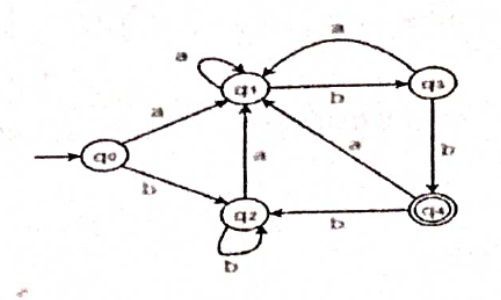20227m
Module 1: Introduction, Regular languages and finite automata
View this question on its own page →Minimize the DFA shown in the following transition diagram:

Q3a. Assume that a regular language L is provided to you as a DFA M(\{Q, \Sigma, \delta, q_0, F\}). How would you check whether L is infinite?20197m
Module 1: Introduction, Regular languages and finite automata
View this question on its own page →Assume that a regular language is provided to you as a DFA . How would you check whether is infinite?
Q3a. Explain the concept of a Finite Automaton. List and describe its main components. Also, differentiate between Deterministic Finite Automaton and Non-deterministic Finite Automaton with suitable examples.20257m
Module 1: Introduction, Regular languages and finite automata
View this question on its own page →Explain the concept of a Finite Automaton. List and describe its main components. Also, differentiate between Deterministic Finite Automaton and Non-deterministic Finite Automaton with suitable examples.
Q3a. Construct an NFA that will accept string of 0's, 1's and 2's beginning with a 0's followed by odd number of 1's and ending with any number of 2's.20217m
Module 1: Introduction, Regular languages and finite automata
View this question on its own page →Construct an NFA that will accept string of 0's, 1's and 2's beginning with a 0's followed by odd number of 1's and ending with any number of 2's.
Q3b. Construct a DFA that accepts all strings over \{0,1\} containing an even number of 0s and an odd number of 1s. Also, write its formal 5-tuple definition.20257m
Module 1: Introduction, Regular languages and finite automata
View this question on its own page →Construct a DFA that accepts all strings over containing an even number of 0s and an odd number of 1s. Also, write its formal 5-tuple definition.
Q4a. Construct finite automaton corresponding to the regular expression: (a+b)^* c d^* e20207m
Module 1: Introduction, Regular languages and finite automata
View this question on its own page →Construct finite automaton corresponding to the regular expression:
Q4a. Convert the regular expression (a + b)abb(a + b) into an equivalent DFA. Show all steps.20257m
Module 1: Introduction, Regular languages and finite automata
View this question on its own page →Convert the regular expression into an equivalent DFA. Show all steps.
- Install PocketlyBudget App•POCKETLY
Pocketly on Android
Log daily food, travel, and hostel expenses instantly. Set monthly spending limits and see where your money goes without complex spreadsheets.
Q4a. Construct a Moore machine which determines the residue mod 3 for each binary string treated as binary integer. And then convert into the corresponding Mealy machine.20197m
Module 1: Introduction, Regular languages and finite automata
View this question on its own page →Construct a Moore machine which determines the residue mod 3 for each binary string treated as binary integer. And then convert into the corresponding Mealy machine.
Q4b. Using Pumping Lemma, prove that the language L = \{0^{n}1^{n} \mid n \ge 0\} is not regular.20257m
Module 1: Introduction, Regular languages and finite automata
View this question on its own page →Using Pumping Lemma, prove that the language is not regular.
Q4b. Design finite state machine or abstract model for binary adder.20197m
Module 1: Introduction, Regular languages and finite automata
View this question on its own page →Design finite state machine or abstract model for binary adder.
Q4b. Design a DFA corresponding to regular expression 1^*(10)^*.20217m
Module 1: Introduction, Regular languages and finite automata
View this question on its own page →Design a DFA corresponding to regular expression .
Q5b. Show that L = \text{palindrome over } \{a, b\} is not regular.20197m
Module 1: Introduction, Regular languages and finite automata
View this question on its own page →Show that is not regular.
Q6a. Prove using pumping lemma for regular languages that the language \{ 0^n / n \text{ is a perfect square} \} is not regular.20227m
Module 1: Introduction, Regular languages and finite automata
View this question on its own page →Prove using pumping lemma for regular languages that the language is not regular.
Q6a. Show that the language L = \{a^{n!} : n \ge 0\} is not regular or not context-free language.20217m
Module 1: Introduction, Regular languages and finite automata
View this question on its own page →Show that the language is not regular or not context-free language.
Q6b. Convert the following DFA to regular expression using the state elimination technique. | State/input | 0 | 1 | |---|---|---| | \to *p | s | p | | q | p | s | | r | r | q | | s | q | r |20227m
Module 1: Introduction, Regular languages and finite automata
View this question on its own page →Convert the following DFA to regular expression using the state elimination technique.
State/input 0 1 s p q p s r r q s q r Q7a. Convert the following NFA to DFA and informally describe the language it accepts. | State/input | 0 | 1 | |---|---|---| | \to p | {p, q} | {p} | | q | {r, s} | {t} | | r | {p, r} | {t} | | *s | \emptyset | \emptyset | | *t | \emptyset | \emptyset |20227m
Module 1: Introduction, Regular languages and finite automata
View this question on its own page →Convert the following NFA to DFA and informally describe the language it accepts.
State/input 0 1 {p, q} {p} q {r, s} {t} r {p, r} {t} *s *t Q7a. State and prove pumping lemma for regular sets.20217m
Module 1: Introduction, Regular languages and finite automata
View this question on its own page →State and prove pumping lemma for regular sets.