
Robotics Control System
117501Unit 3.0: Time Response Analysis
Q1g. A system has poles at -2 and -4. What can be said about its time response? (i) Oscillatory (ii) Slow response (iii) Overdamped (iv) Underdamped20242m
Unit 3.0: Time Response Analysis
View this question on its own page →A system has poles at and . What can be said about its time response?
(i) Oscillatory
(ii) Slow response
(iii) Overdamped
(iv) UnderdampedQ3a. The block diagram of a simple servo system is shown below 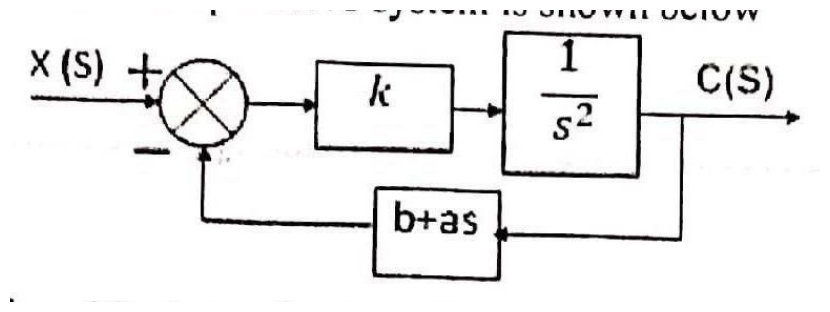 (i) If k = 10, determine the values of 'a' and 'b' to give an overshoot of 16\% and a time constant of 0.1 sec to a unit step input. (ii) Determine t_r, t_p, \omega_d and t_{ss} if k = 40.20247m
Unit 3.0: Time Response Analysis
View this question on its own page →The block diagram of a simple servo system is shown below

(i) If , determine the values of 'a' and 'b' to give an overshoot of and a time constant of sec to a unit step input.
(ii) Determine , , and if .Q6a. The open-loop transfer function of a unity feedback system is given by G(s) = \frac{k}{s(1 + sT)} where k and T are positive constants. By what factor should the amplifier gain be reduced so that the peak overshoot of the unit-step response of the system is reduced from 75\% to 25\%.20247m
Unit 3.0: Time Response Analysis
View this question on its own page →The open-loop transfer function of a unity feedback system is given by
where and are positive constants. By what factor should the amplifier gain be reduced so that the peak overshoot of the unit-step response of the system is reduced from to .