
Back to the 2026 paper
Similar questions
Formal Language & Automata TheoryConsider the following finite state automaton: 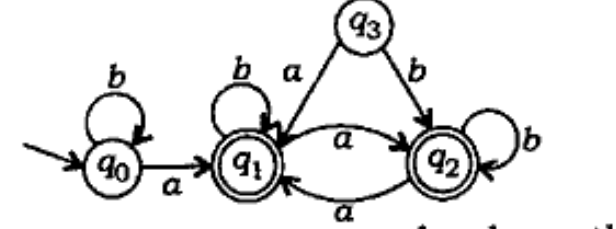 The language accepted by this automaton is given by the regular expression (i) b^*ab^*ab^*ab (ii) (a+b)^* (iii) b^*a(a+b)^* (iv) b^*ab^*ab20192m Compiler DesignConvert the regular expression (a+b)^*ab into NFA.20257mFORMAL LANGUAGE & AUTOMATA THEORYIf \Sigma = \{a, b\}, then \Sigma^* contains (i) Only finite strings (ii) Only infinite strings (iii) All finite strings over \Sigma including \epsilon (iv) Only strings of equal length20252mFormal Language & Automata TheoryWhich of the following pairs of regular expressions are equivalent? (i) x^* and x^*x (ii) 1(01)^* and (10)^*1 (iii) x(xx)^* and (xx)^*x (iv) All of the above20222m
PreviousConsider the statement: int total = 25; Which of the following represents a lexeme? (i) int (ii) 25 (iii) total (iv) All of the AboveNextWhich of the following is a problem for a top-down parser? (i) Left recursion (ii) Right recursion (iii) Ambiguity only (iv) Bottom-up derivation
Budget AppAndroid App
Pocketly on Android
Log daily food, travel, and hostel expenses instantly. Set monthly spending limits and see where your money goes without complex spreadsheets.