Back to the 2021 paper

Module 3: Network Layer & Routing

20217m

With a neat diagram, explain distance vector routing protocol.

Worked SolutionAI Assisted

Distance Vector Routing

Distance vector routing is a distributed, iterative, asynchronous algorithm based on the Bellman-Ford equation. Each router maintains a table (a "vector") giving the best-known distance to every destination and the next hop towards it, and exchanges this vector only with its immediate neighbours. No router ever learns the full topology. Example protocol: RIP (uses hop count, max 15 hops).

Principle

Dx(y)=min⁡v{c(x,v)+Dv(y)}D_x(y) = \min_v \left\{ c(x,v) + D_v(y) \right\}

The least cost from x to y is the cheapest of: the direct cost to a neighbour v plus v's currently known least cost to y. Each router repeatedly advertises its vector, applies the equation to the neighbours' advertisements, and updates its table until no entry changes (convergence).

Network diagram

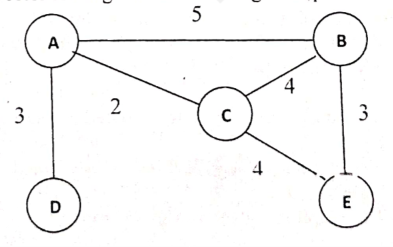
           2                3
      A --------- B --------------- C
       \                       /
        \                     /
         4                   5
          \                 /
           \               /
             ------ D ----

   (A-B = 2, B-C = 3, A-D = 4, D-C = 5)

Operation at router A

  1. Initialisation (only direct links): A knows A = 0, B = 2 (via B), D = 4 (via D), C = ∞.
  2. First exchange: A receives vectors from neighbours B and D.
    • B advertises: "I can reach C in 3 hops, D in ∞, myself 0."
    • D advertises: "I can reach C in 5 hops, B in ∞, myself 0."
  3. Apply Bellman-Ford:
    • C: min(∞, 2 + 3, 4 + 5) = 5 via B
    • B: min(2, 4 + ∞) = 2 (unchanged) — D: min(4, 2 + ∞) = 4 (unchanged)
  4. Table now stable (converged).

Final distance table at A:

Destination Cost Next hop
A 0 —
B 2 B
C 5 B
D 4 D

The same computation runs simultaneously in every router, each building its own table from its neighbours' vectors.

Properties

Aspect Detail
Knowledge Local — only neighbours' vectors, no global topology
Communication Periodic (RIP: every 30 s) and on-change updates to neighbours only
Advantages Simple, minimal computation, very low overhead, little memory
Disadvantages Count-to-infinity problem, transient routing loops, slow convergence after a failure
Remedies Split horizon, poison reverse, triggered updates, hold-down timers
Cost metric Must be additive (hop count, delay) — unlike link state, which can use any metric

Summary: each router "believes" its neighbours about destinations it does not know directly, so a bad or stale advertisement propagates slowly and can drive the cost to infinity during a failure — the main weakness compared with link state routing.

Similar questions

Budget AppAndroid App

Pocketly on Android

Log daily food, travel, and hostel expenses instantly. Set monthly spending limits and see where your money goes without complex spreadsheets.