
Back to the 2024 paper
Similar questions
Computer NetworksDescribe RIP routing protocol with an example. Explain count to infinity problem and its countermeasures.202214mComputer NetworksWhat are the functions of a RIP message? List the RIP shortcomings and their corresponding fixes.20167mComputer NetworksWhich one of the following is TRUE interior Gateway routing protocols - Routing Information protocol (RIP) and Open Shortest Path First (OSPF)? (i) RIP uses distance vector routing and OSPF uses link state routing (ii) OSPF uses distance vector routing and RIP uses link state routing (iii) Both RIP and OSPF use link state routing (iv) Both RIP and OSPF use distance vector routing20162mComputer NetworksWhich the following is an inter-domain routing protocol? (i) RIP (ii) OSPF (iii) BGP (iv) Both (a) & (b)20232m
PreviousAn ISP is granted a block of addresses—starting with 190.100.0.0/16 (65,536 addresses). The ISP needs to distribute these addresses to three groups of customers as follows: a. The first group has 64 customers; each needs 256 addresses. b. The second group has 128 customers; each needs 128 addresses. c. The third group has 128 customers; each needs 64 addresses. Design the subblocks and find out how many addresses are still available after these allocations.NextExplain the distance vector routing for the following example. 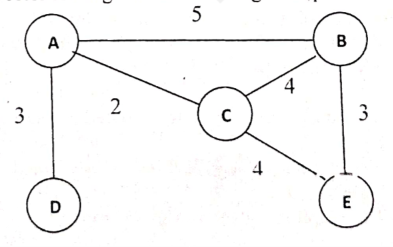
Official AppAndroid App
PYQDeck for Android
Solve BEU previous-year exam papers anywhere, anytime. Fast search, offline paper viewing, and step-by-step solutions designed specifically for your phone.