
Robotics Control System
117501Unit 2.0: Mathematical Modelling
Q1b. A system is observable if: (i) States can be measured from outputs (ii) Inputs are visible (iii) Poles are real (iv) Transfer function exists20242m
Unit 2.0: Mathematical Modelling
View this question on its own page →A system is observable if:
(i) States can be measured from outputs
(ii) Inputs are visible
(iii) Poles are real
(iv) Transfer function existsQ1d. Why are electrical analogies used in control systems? (i) For heating purposes (ii) To make the system unstable (iii) For simplified modeling (iv) To avoid complexity20242m
Unit 2.0: Mathematical Modelling
View this question on its own page →Why are electrical analogies used in control systems?
(i) For heating purposes
(ii) To make the system unstable
(iii) For simplified modeling
(iv) To avoid complexityQ1i. For system A = \begin{bmatrix} 0 & 1 \\ -1 & -3 \end{bmatrix}, B = \begin{bmatrix} 0 \\ 1 \end{bmatrix}, check controllability using rank. (i) Rank = 2, controllable (ii) Rank = 1, uncontrollable (iii) Rank = 2, not observable (iv) Rank = 1, observable20242m
Unit 2.0: Mathematical Modelling
View this question on its own page →For system , , check controllability using rank.
(i) Rank = 2, controllable
(ii) Rank = 1, uncontrollable
(iii) Rank = 2, not observable
(iv) Rank = 1, observableQ5b. The SFG of a control system is shown in the figure below. Find the transfer function C/R. 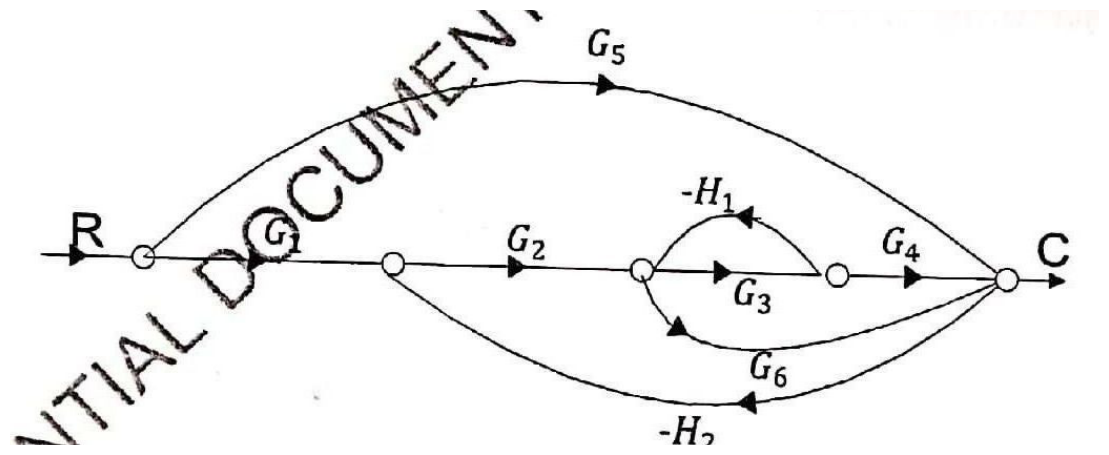20247m
Unit 2.0: Mathematical Modelling
View this question on its own page →The SFG of a control system is shown in the figure below. Find the transfer function .

Q8b. Consider the mechanical system shown in the figure below. Find the transfer function G(s) = \frac{V_1(s)}{F(s)} 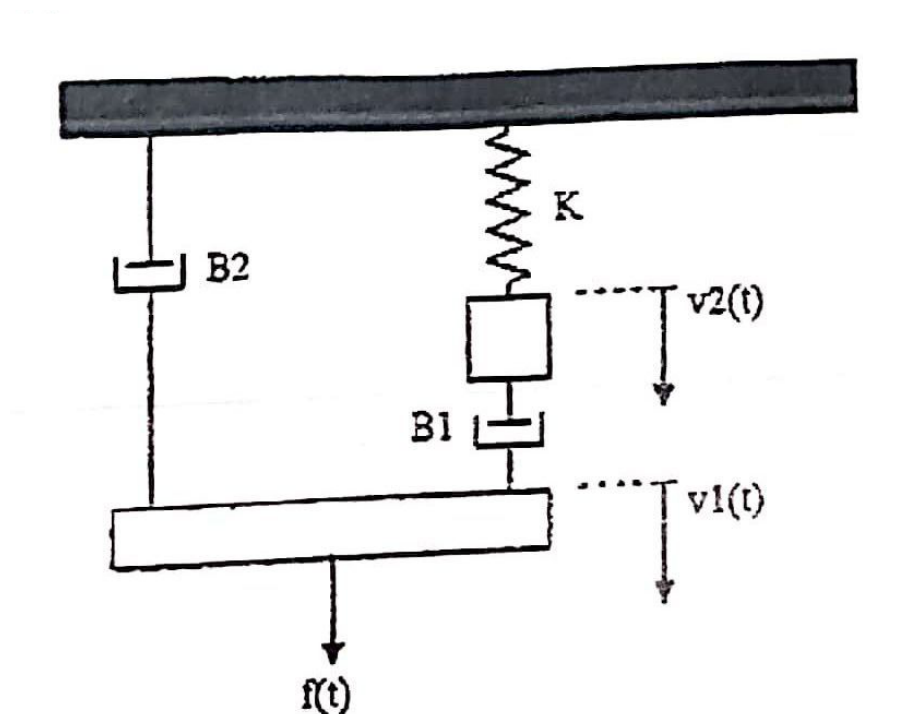20247m
Unit 2.0: Mathematical Modelling
View this question on its own page →Consider the mechanical system shown in the figure below. Find the transfer function
